



WBUR Article Features Breast Imaging Technology Research at UMass
Gopal Vijayaraghavan, MD MPH and Mohammed Salman Shazeeb, PhD were featured in a recent article on WBUR about research using AI technology and MRI to predict breast cancer before it happens.
by Priyanka Dayal McCluskey
Senior Health Reporter, WBUR
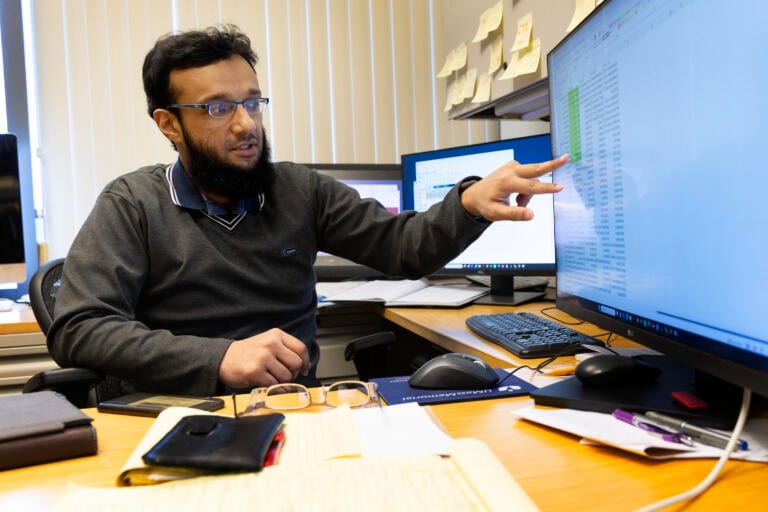
At the University of Massachusetts Chan Medical School, researchers built a makeshift data center — a tower of humming servers — to power their work on breast cancer prediction.
They tested Barzilay’s Mirai technology on 65,000 patients who get regular mammograms at UMass Memorial Health. The AI found that 4,000 were at high risk for developing cancer, even though doctors hadn’t noticed any suspicious signs in their mammograms.
Ultimately, 145 high-risk patients took part in a study, the first in the country using Mirai to predict patients’ future risk, instead of looking at older data. Each participant received a breast MRI, a test that is more precise and about four times more expensive than a mammogram. The MRIs revealed that half a dozen patients already had cancer.
“It was like, ‘Oh my god, we have to use this tool more often,’ ” said Mohammed Salman Shazeeb, an associate professor of radiology at UMass Chan who co-led the study.
The other lead researcher, Dr. Gopal Vijayaraghavan, said the AI tool appears to be useful, but bringing it to more patients will be costly. One reason is that insurance companies are unlikely to pay for a patient’s MRI based solely on an AI projection. The average breast MRI in Massachusetts costs $1,400, according to state data compiled at WBUR’s request.
“There are a lot of hurdles,” said Vijayaraghavan, a professor of radiology and breast imaging specialist. “That's part of the reason why all these AI things are only being done in rich hospitals … who are willing to eat a bit of the cost.