


Request for Applications Process: H3S
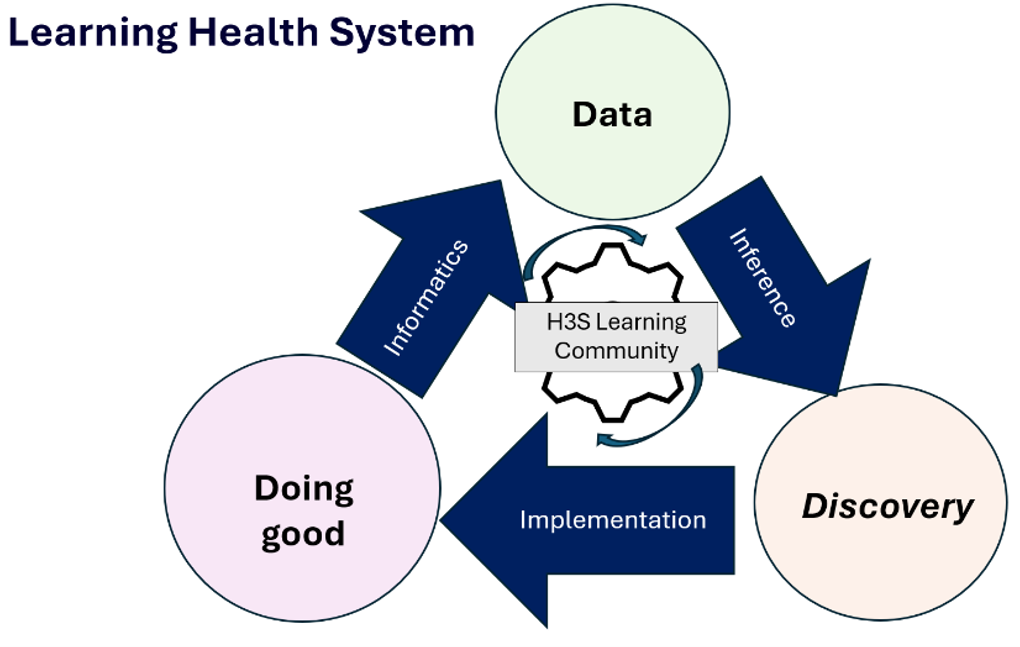
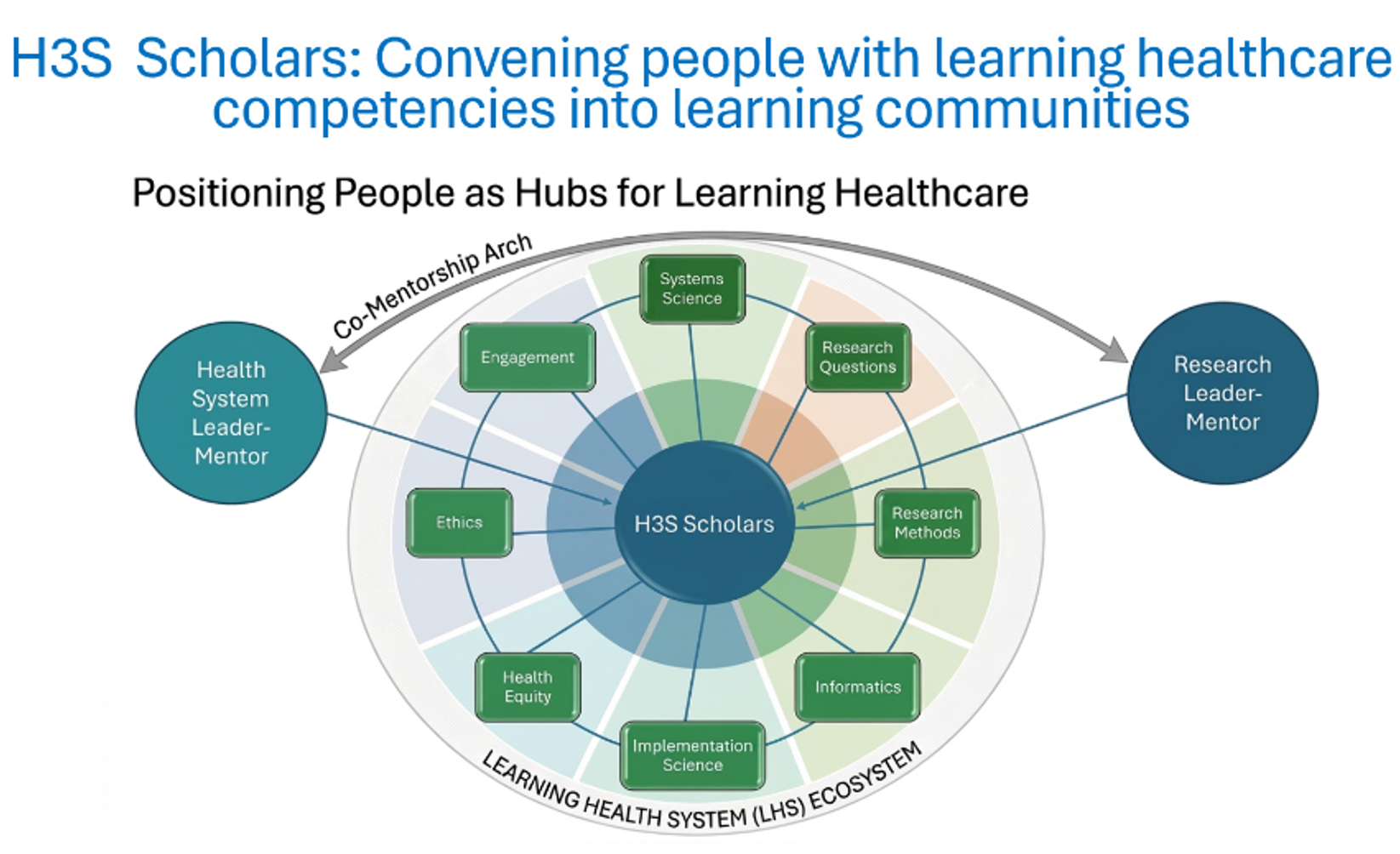
- Systems Science
- Moving from Clinical Questions into Research Questions,
- Real-world Research Methods
- Informatics and Data
- Implementation and Improvement Science
- Health Equity
- Research Ethics
- Engagement.
While most institutions have people with LHS Competencies, systems thrive when these people are purposefully assembled into working units to tackle real-world problems. H3S seeks to train its Scholars in the fundamentals of LHS Competencies, so that they can skillfully convene teams to tackle problems in healthcare delivery and population health.
-
H3S Program provides salary support, mentorship, personnel and infrastructure to support projects designed to improve healthcare delivery.
- Applicants will identify one academic and one health system leader to serve as co-mentors, and the co-mentors will work together to hone project objectives, design, and evaluation plans.
- Applicants will supplement experiential learning with didactics through health systems science lectures (e.g., Implementation Science, Engagement and Equity, Systems Science, Real-World Research Designs, Digital Medicine) that are designed to provide space for project discussion and further opportunities to grow collaborations with other on-campus learners.
- Research and Health System Leader Mentorship and access to courses
- 25% FTE support for up to two years from CCTS.
- Potential for additional Departmental support to supplement the CCTS effort support (5% -25% additional FTE to reach a maximum of 50% FTE total)
- Research coordinator, analyst, statistical, data and qualitative supports assigned per project goals
-
Support for capstone project planning from concept to publication
- Faculty: Post-graduate, early/mid-career clinicians (Physicians, Nurses, Advance Practice Providers, PT/OT/RRT), and scientists seeking new training and experience in health systems sciences.
- Clinicians bring lived experience with the health system challenges, may have ideas for solutions, but may be unsure how to convene LHS teams to design and evaluate projects.
-
Research scientists may have highly impactful healthcare delivery research questions and bring experience with specific methods, but may not have access to clinical operations or understand workflow barriers or methods specific to applied Health Systems Science.
- Hospital-acquired venous thrombo-embolism risk estimation and risk reduction
- Hospital readmissions risk reduction among patients with a history of frequent hospitalizations
- Improved inpatient triage, access and flow to most appropriate campus, setting, or level of care
- Inpatient handwashing measurement/improvement
- Reducing inpatient falls
- Improved capture of patient problems and history in notes
- Harmonized measures of ambulatory care quality across settings, specialties and disciplines
- Staff vaccination
- Please enquire to suggest other potential areas
- Application release date: June 12, 2026
- Application due date: July 10, 2026
- Decision: July 24, 2026
- Start: August 2026
- Customized Academic-based and Health System-based mentorship team tailored to the health system challenge
- Partnership between UMass Chan and affiliated health systems around priority areas
- Support through CCTS and Division of Health System Science resources
-
Establishment of avenues and processes for increased collaboration
For questions about the H3S program, application process, potential mentorship teams, mentor recommendations, or projects, please contact Dr. Allan Walkey at allan.walkey1@umassmed.edu
H3S Application
Due Date July 10, 2026
Name:
Email:
Title/role:
Department:
Potential Academic Leader Mentor (UMass Chan):
Potential Health System Leader Mentor (UMMH, Baystate, Lahey, depending on project site):
-------------------------------------------------------------------------------------------------------------------
Short answer application questions. Please answer the following 5 questions about your Career and Project Plans. Please also submit a CV/Resume with your application.
-
Why do you want to become a Health Systems Science Scholar? What career trajectory led you to apply? What would your future career plans and goals be after completing H3S (what will you do your new skills)? (<500 words)
-
In which Learning Health System competencies do you currently have expertise? Which Learning Health System competencies are you particularly interested in developing further? (< 500 words)
-
What specific healthcare delivery or clinical challenge(s) are you interested in solving? What would success look like?
-
What has been tried before to address this problem and what were the key barriers or limitations to progress? What new approaches to address your problem of interest might be successful? (< 1000 words) (While we do not require a proposed solution, ideas regarding an intervention, process change, use of technology, etc. can be helpful. Please be as concrete as possible.)
-
What types of personnel assistance do you predict would need to be convened and supplied to address your challenge of interest? (<300 words)
Please also provide a signed letter with a statement of support from your Supervisor/Chair acknowledging that at least 25% of your Full Time Equivalent (FTE) time will be devoted to H3S. The Supervisor should also state in the letter whether or not any additional resources from your Department or Division will be supplied to supplement the project (examples may include: additional %FTE support up to 50% total, research project costs or infrastructure, research staff, data/informatics/EMR resources, other).
For questions about the H3S program, application process, potential mentorship teams, mentor recommendations, or projects, please contact Dr. Allan Walkey at allan.walkey1@umassmed.edu