

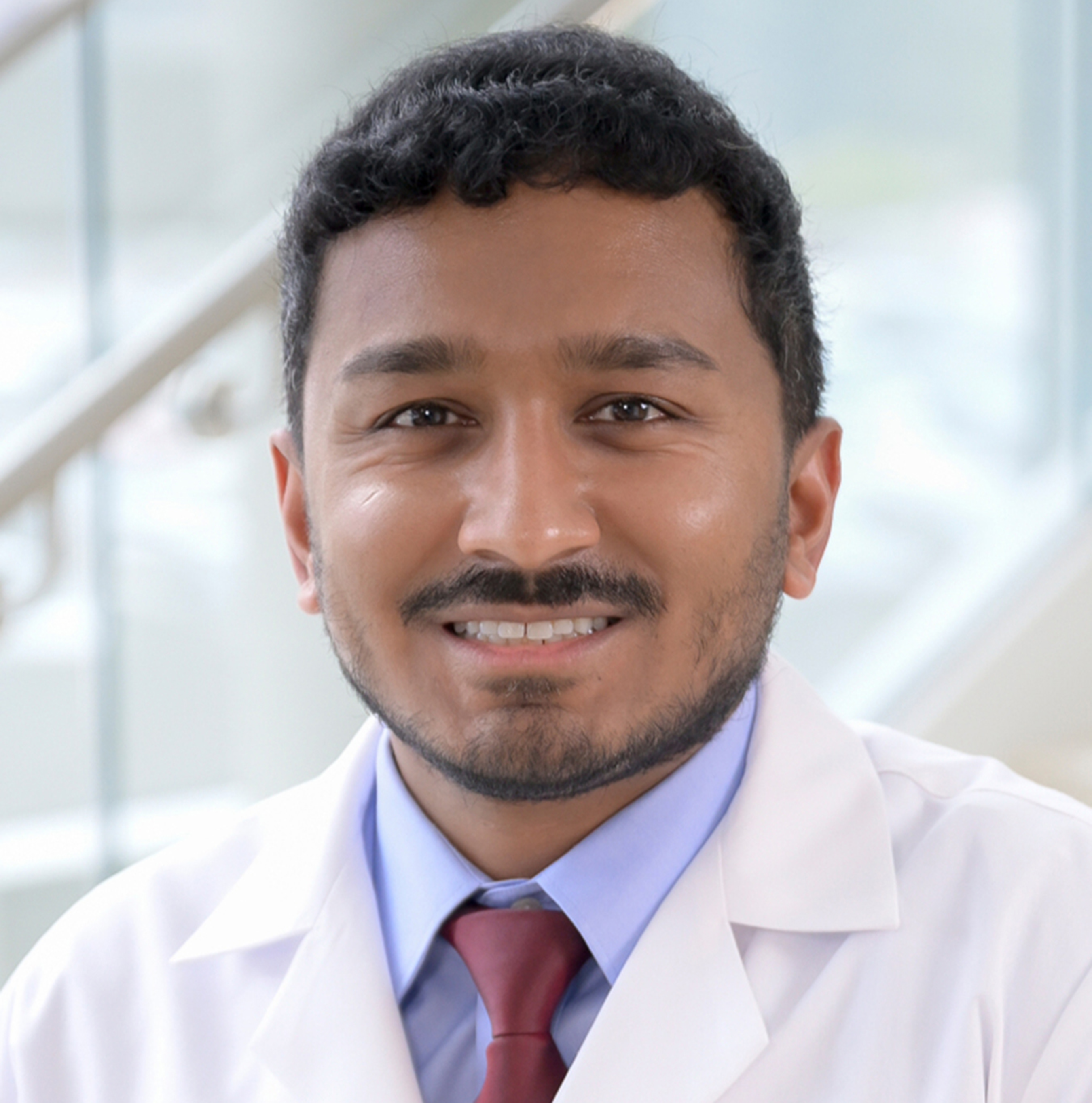
Varun Ayyaswami, MD
 By DoM Communications | Date published: February 13, 2026
February Researcher Spotlight: Varun Ayyaswami, MD
In this month’s Researcher Spotlight, we feature Varun Ayyaswami, MD, assistant professor of medicine in the Division of General Internal Medicine and Health Systems Science. Dr. Ayyaswami’s current research focuses on digital health interventions and obesity medicine.
Dr. Ayyaswami earned his bachelor's degree in biological sciences from the University of Pittsburgh in Pittsburgh, Pennsylvania. He went on to receive his medical degree from the University of Maryland Medical School in Baltimore, Maryland, and completed his Internal Medicine residency at UMass Chan.
During medical school, Dr. Ayyaswami developed an interest in digital health, particularly digital health literacy. That interest expanded during his Internal Medicine residency, when he began focusing on obesity medicine under the mentorship of faculty in the field.
“This was a time when GLP-1 medications like semaglutide and tirzepatide were just completing trials for patients with obesity and not being used widely, so I became really interested in thinking about how to use them in clinical practice, since we were not using them at the time,” said Dr. Ayyaswami. “We did a quality improvement study on how to actually implement them in primary care and simultaneously began thinking about how you combine those with lifestyle changes, such as nutrition and physical activity.”
These experiences sparked ideas about integrating digital health interventions with GLP-1 therapies to improve metabolic health, including weight loss and body composition changes. As a third-year Internal Medicine resident, Dr. Ayyaswami participated in an ARC pilot study that explored incorporating wearable device data, such as information from Fitbits, into the electronic medical record to support physical activity interventions.
Most recently, Dr. Ayyaswami concluded a pilot study funded by the Mel Cutler Population Health Pilot Research Award with colleague Jamie Farro, PhD, assistant professor of medicine in the Division of Health Informatics and Implementation Science. The study examined how lifestyle interventions can be combined with anti-obesity medications, specifically GLP-1 medications, using embedded health coaching within primary care settings.
“One of the challenges that we saw in our previous studies is that primary care physicians don’t have adequate time or resources to comprehensively discuss nutrition and physical activity such as resistance training,” explained Dr. Ayyaswami. “These patients in our study were given multiple sessions with a health coach, and overall, it looks to be a feasible intervention within primary care. We are looking at outcomes like body composition and weight change combined with the coaching, and we are optimistic about the intervention.”
Beyond his research, Dr. Ayyaswami co-leads an embedded weight management clinic within Benedict Primary Care alongside Jeevarathna Subramanian, MD, associate professor of medicine in the Division of General Internal Medicine, which directly informs his research efforts. “It’s been very helpful to have the clinical experience of treating patients with medical and lifestyle interventions to promote healthy weight loss and seeing the associated challenges within the healthcare system, which can directly inform research questions to pursue,” explained Dr. Ayyaswami.
In speaking of his work, Dr. Ayyaswami notes that one of the key challenges in digital health is integrating certain device data into the medical record. “It’s challenging from a technical and resource perspective,” said Dr. Ayyaswami. “Patients now have access to wearable devices and getting that data accessible to the provider or healthcare team in a format that can be beneficial for patient care can be very challenging.”
Dr. Ayyaswami finds that the most rewarding aspect of his research and clinical work is seeing meaningful progress in interventions to improve care for patients with obesity over time. “What’s really rewarding is seeing the progress and the different results. It’s very satisfying to be able to do something that you hope is going to benefit patients and their overall health,” said Dr. Ayyaswami.
Looking ahead, Dr. Ayyaswami plans to focus on evaluating and implementing artificial intelligence (AI) chatbots to provide beneficial information to patients to help them reach their health goals. He explains that AI could have the ability to give patients exercise-based advice or counseling on nutrition in conjunction with GLP-1 treatment. He also hopes to explore digital health interventions that promote medication adherence and persistence, helping patients taking GLP-1s remain on their prescribed medications for longer periods.
We look forward to Dr. Ayyaswami’s continued contributions to digital health research, obesity medicine, and patient care!