

By: DoM Communications
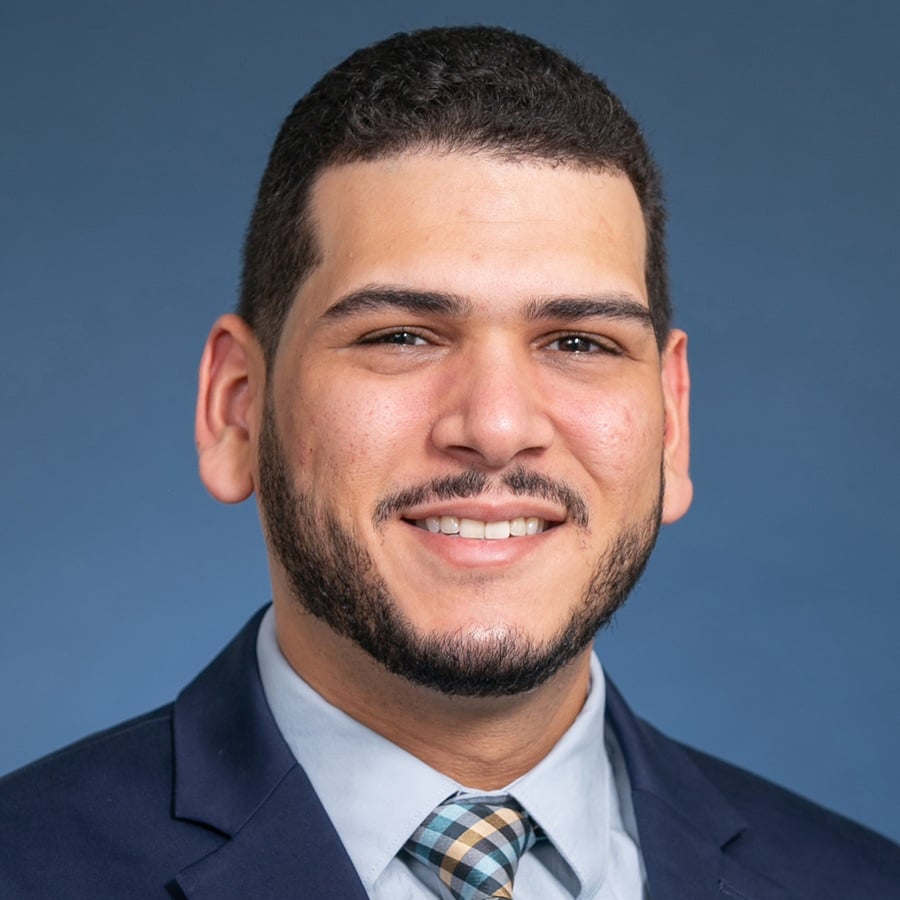 In this month’s Chair’s Spotlight, we feature Victor Acosta-Rivera, MD, assistant professor of medicine in the Division of General Internal Medicine.
Dr. Acosta-Rivera always knew he wanted to help people, though he did not initially see himself becoming a primary care provider. “I never thought I was going to end up in primary care. I thought that was far from what I wanted to do. I thought I was going to be something more technical, like a surgeon,” shared Dr. Acosta-Rivera.
As he progressed through his medical training in Puerto Rico, Dr. Acosta-Rivera became more immersed in the field and began spending more time with patients. “This is when I realized I can provide the most care,” said Dr. Acosta-Rivera. “When I was doing my outpatient rotations, family medicine, primary care, home visits, and community work, this is when I fell in love with everything.”
Dr. Acosta-Rivera earned his bachelor’s degree at Universidad del Sagrado Corazón in San Juan, Puerto Rico. He went on to complete both his master's and medical degree at Ponce Health Sciences University in Ponce, Puerto Rico. In 2024, he completed his internal medicine residency, primary care track, at UMass Chan Medical School, where he was an active member of the Diversity Action Council.
“My practice during residency was in the Benedict clinic, and I was very surprised about the patient population that we were treating, a population that specifically resonated with me and their complexity and needs,” said Dr. Acosta-Rivera. “It reminded me of the things I saw back home, and it reminded me of why I wanted to practice medicine.”
As a native Spanish speaker, Dr. Acosta-Rivera knew he wanted to remain at UMass, where he could care for a diverse patient population, particularly those seeking a Spanish-speaking physician.
At UMass, Dr. Acosta-Rivera is developing a home-based primary care initiative aimed at making medical services more equitable and accessible. For some patients, traveling to the University campus presents significant challenges, including limited access to specialized transportation, hazardous weather conditions, and other barriers. Dr. Acosta-Rivera hopes to one day bring primary care into the homes of patients who are unable to visit clinics due to demographic obstacles. “I want to make things more equitable for patients, so I figured, why not send out the physician as well?” said Dr. Acosta-Rivera.
Another of Dr. Acosta-Rivera’s goals is to extend appointment times for patients who require interpreter services. “One of the barriers I see in the clinic is language,” he explained. “We’ve done a lot to overcome this with the help of interpreter services; however, patient visits are often shorter as interpretation takes up a good chunk of time of the visit. In the future, I would like to work on flagging medical records of those who need interpreter services and, as a result, extending the lengths of their visits to accommodate the translation part.” By doing so, Dr. Acosta-Rivera aims to make each patient’s visit more equitable, ensuring that every patient receives the same quality of care.
In delivering patient care, Dr. Acosta-Rivera finds that taking a humanistic approach brings him the most joy in his work. “When you really scale things down and make simple changes, such as going to the patient’s home, figuring out their diet, talking about topics outside of the realm of medicine, you get to know them a little bit better, and that’s what resonates with them and gets us to have a better working relationship,” said Dr. Acosta-Rivera.
He also believes it is essential that the patient fully understands what was discussed during their visit and what the next steps will be. “I have patients who thank me for spending the time with them, and it definitely brings me a lot of joy, even if it’s a small win,” he shared.
Although forming these relationships can be deeply rewarding, Dr. Acosta-Rivera finds that it can also be very challenging, as physicians are expected to see large numbers of patients within limited time constraints. “You may not get to go into the level of detail that you want to sometimes, and having to work with time constraints can be challenging,” said Dr. Acosta-Rivera. “Despite these challenges, those little details are definitely important.”
Looking ahead, Dr. Acosta-Rivera hopes to continue making small changes in his work, efforts that can have a large, meaningful impact on UMass.
We thank Dr. Acosta-Rivera for his dedication to the department and his patients!