Search Close Search
Search Close Search
Page Menu

The College Faculty Guide to Academic Supports for College Students with Serious Mental Health Conditions

Date Posted: Friday, January 14, 2022

black male and female college students sitting outside reviewing a notebook

The Peer Academic Supports for Success (PASS) program is a research-informed, comprehensive academic peer coaching program for college students with mental health conditions. PASS is designed to help students thrive by providing health-based, strengths-focused, and supportive academic peer coaching. PASS offers additional support to mitigate student challenges and promote persistence in college, ensuring they stay on track toward their goals.

For more information on PASS, contact Paul Cherchia, M.A., LMHC. Assistant Director, College Mental Health Programs at Boston University. cherchia@bu.edu or 617.353.6628.

▼ Open All
|
▲ Close All

About the PASS Program

PASS Program Model and History

Peer Support and Resiliency: The PASS Approach

A Resiliency and Wellness Framework

Program Dissemination

The UMass Training and Technical Assistance Team has partnered with colleges and universities across the United States in the successful adaptation and adoption of our PASS program to meet the ever-increasing needs of young adults with mental health conditions on college campuses. 

3 people grouped together icon

Partnership

PASS is inspired by RASE (Raiders of the Autism Spectrum Excelling), a comprehensive peer coaching program for college students with autism spectrum disorder transitioning from high school to college at Wright State University in Dayton, Ohio. PASS is a modified version of RASE, that was implemented at Boston University in collaboration with UMass Medical and edited to meet the needs of college students with mental health conditions. PASS has now partnered in disseminating the program at the University of Massachusetts Boston and Rowan University.  

presenter with screen icon

Knowledge Translation

PASS is a peer-based academic coaching program that provides academic support and facilitates growth in five key competency areas: Structure, Technology, Emotional Agility, Advocacy, and Resiliency. Peer Coaches are trained and closely supervised by a PASS Peer Coach Supervisor, a professional on campus who serves as both a mentor and role model for coaches. As a partner in PASS, you will have full access to training, supervision, and peer coaching manuals for as well as access to observe PASS supervision to best learn the content and delivery of the program, a “train-the-trainer model”. 

wrench and screwdriver overlapping to form an X

Technical Assistance (TA)

We work closely with your team to ensure you are optimally prepared to recruit coaches, supervise coaches, and implement the PASS program to help the students of your university, college, or program. We help your team with all aspects of program implementation, including supporting your familiarity with the manuals, as well as proven key peer coaching strategies. We also support your team in developing specific content adjustments and coaching strategies that may best fit the needs of your specific school or program.  

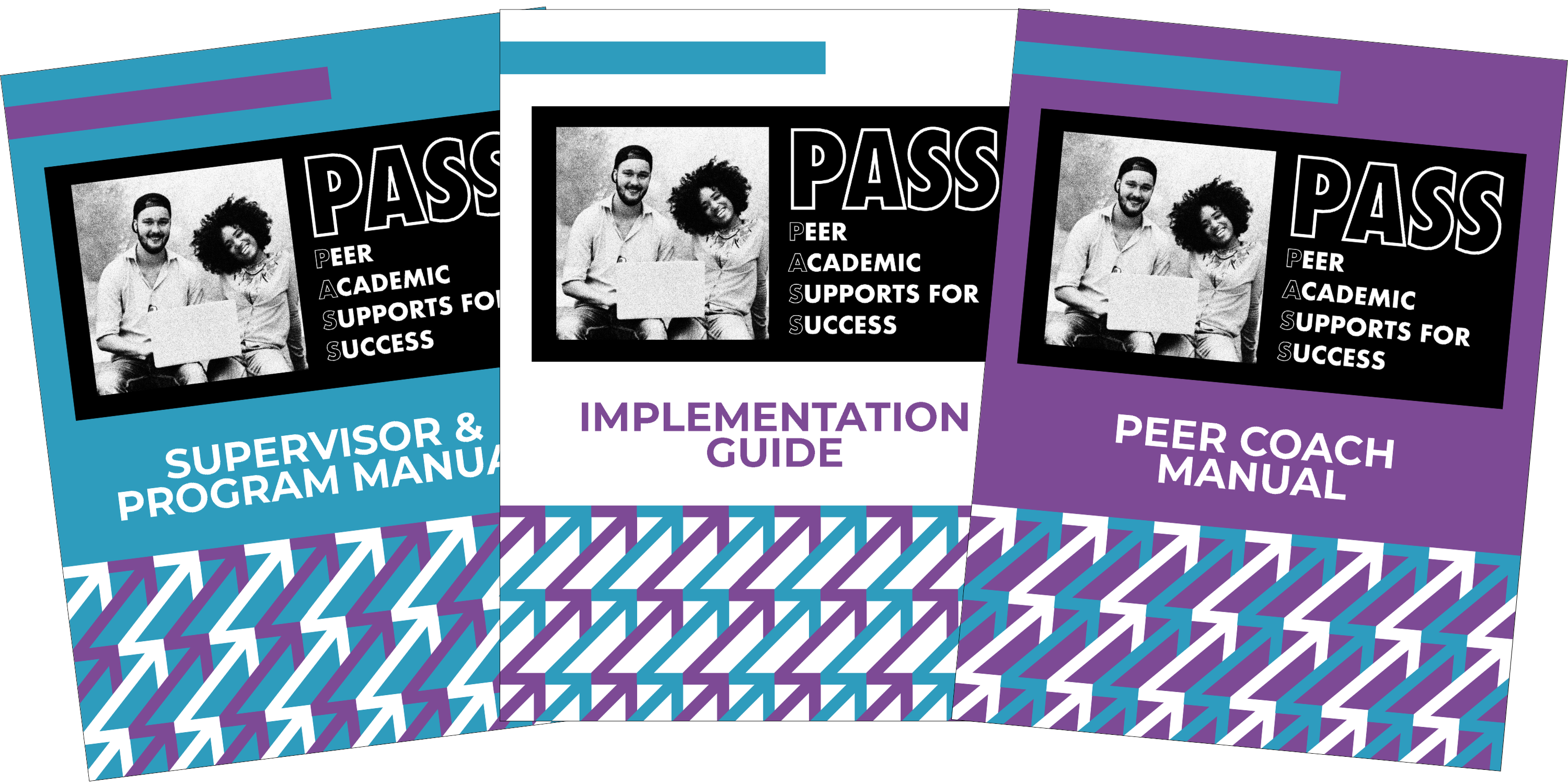
spread of the PASS manualsPeer Coach Manual: 

This manual is a guide for PASS Peer Coaches, outlining expectations, responsibilities, and support structures. PASS coaches help college students with mental health conditions succeed academically and personally by promoting wellness, advocacy, resilience, and effective study habits.

It includes reference materials for initial training and ongoing guidance. Key tasks include submitting peer coach logs, attending supervision meetings, conducting one-on-one sessions, and completing a self-assessment at the end of the term. Clear communication and collaboration among coaches and supervisors are essential for effective student support.

Supervisor Program Manual:

The PASS Supervisor’s Manual provides comprehensive guidance for implementing and managing the Peer Academic Support and Success (PASS) program, which supports college students living with mental health conditions. It outlines the supervisor’s critical role in recruiting, training, and mentoring peer coaches, coordinating with campus partners, and maintaining program fidelity. The manual emphasizes the importance of empathy, flexibility, and wellness in supervision, offering strategies for fostering trust-based coaching relationships and promoting student success. It also includes practical tools for interviewing, training, and supporting coaches, as well as navigating campus systems and resources to ensure effective program delivery.

Implementation Guide:

This implementation guide is a practical resource for colleges and universities seeking to support students with mental health conditions through the Peer Academic Supports for Success (PASS) program. Designed for higher education leaders, staff, and faculty, it complements the PASS Peer Coach and Supervisor Manuals by offering evidence-based strategies for launching, sustaining, and integrating the program across campus services. The guide is applicable to any 4-year institution and can be used both during initial planning and throughout program operation to ensure effective support and long-term success.

For more information or to obtain the PASS Manuals, please contact Paul Cherchia, M.A., LMHC. Assistant Director, College Mental Health Programs at Boston University. cherchia@bu.edu or 617.353.6628