



UMass Diabetes Center of Excellence Researchers Recognized in Cell Metabolism's 100 Years of Insulin Issue
Michael Czech, PhD and Silvia Corvera, MD reflect on the privilege of studying insulin
Date Posted: Friday, April 16, 2021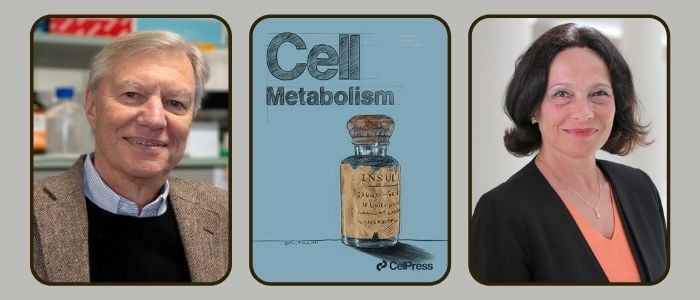
2021 marks the 100th anniversary of the first life-saving treatment for diabetes. On July 27, 1921, Dr. Frederick Banting and medical student Charles Best successfully isolated the insulin hormone for the very first time at the University of Toronto. Their breakthrough transformed diabetes treatment forever. Banting & Best: Discovery of Insulin
The April 2021 issue of the scientific journal Cell Metabolism includes stories of scientists and clinicians whose research has advanced our understanding of insulin, islet biology and diabetes.
Two researchers from UMass Chan Medical School’s Diabetes Center of Excellence and Program in Molecular Medicine, Michael P. Czech, PhD, and Silvia Corvera, MD, are among those who were featured:
The Privilege of Studying Insulin
Research on insulin and its actions was at a fever pitch during the years 1975 to 1985. This period spanned the gap from being limited to measuring insulin binding to its mysterious membrane receptor and the cloning of its cDNA. During this frenzied period on a bright afternoon in 1978, Paul Pilch in the Czech lab at Brown University held up an autoradiograph from his experiment, designed to identify the insulin receptor by affinity crosslinking. Our elation skyrocketed as a remarkable single dark band emerged against an otherwise apparent background. Over the next two years, Joan Massague, along with Paul and others in our group, utilized the technique to correctly deduce the insulin receptor’s heterotetrameric subunit configuration and demonstrate a similar structure for the IGF-1 receptor. We denoted the two receptor subunits as a and b in PNAS in 1980, which has stood the test of time. This exhilarating run of exciting discovery still brings a smile to all those involved 40 years ago. What a privilege to be a scientist!
Despite numerous successes in hundreds of labs, the need to translate basic discoveries into the diabetes clinic has never been more urgent. Combining powerful technologies in this effort is now our aim. We are combining the Corvera lab’s technology, which generates large numbers of human adipose tissue stem cells, with the Czech lab’s CRISPR-based methods to enhance their therapeutic potential further. Might metabolic diseases be treatable by cell therapies? In humanized mice, we recently found that implanting CRISPR-enhanced 'supercharged' human adipocytes lowers blood glucose more effectively than unmodified adipocytes. Indeed, still a privilege to be a scientist!
View the full article in Cell Metabolism titled “Voices: Insulin & Beyond”
Related Stories:
The Corvera Lab is Examining How Different Body Fat Plays a Role in Type 2 Diabetes