Search Close Search
Search Close Search
Page Menu

Doctoral Degree Completion Data

Student Completion and Retention Rates and Average Time to Degree

We recognize that our mean and median time to degree is considered to be long, and we are taking active steps to ensure that Morningside Graduate School of Biomedical Sciences students complete an impactful body of work in timely manner. These steps include streamlining curricular requirements, monitoring timely completion of the qualifying exam, monitoring student scientific development and progress, and articulating clear standards for degree completion. Impacts of changes made over the last five years will be measured by tracking the six-year completion rate for each cohort.

Completion Rates

75% of matriculating students received a PhD terminal degree and an additional 4% received a Master of Science as a terminal degree.  Completion rates were calculated for cohorts entering 2008-2012 and completing by 2020 (based on 150% average time to PhD = 9 years)

Retention Rates

The retention rate of first year students entering their second year of graduate study for the three most recent years is:  Fall 2020 = 98%, Fall 2019 = 95%, Fall 2018 = 94%

Time to Degree

For the most recent 10-year period (2010-2020), the time to degree (TTD) for all PhD graduates from the Basic Biomedical Sciences (BBS) division of the Morningside Graduate School of Biomedical Sciences was 6.6 years. 

Time to Degree

Median Time to Degree by 3-Year Graduating Class 2000-2020
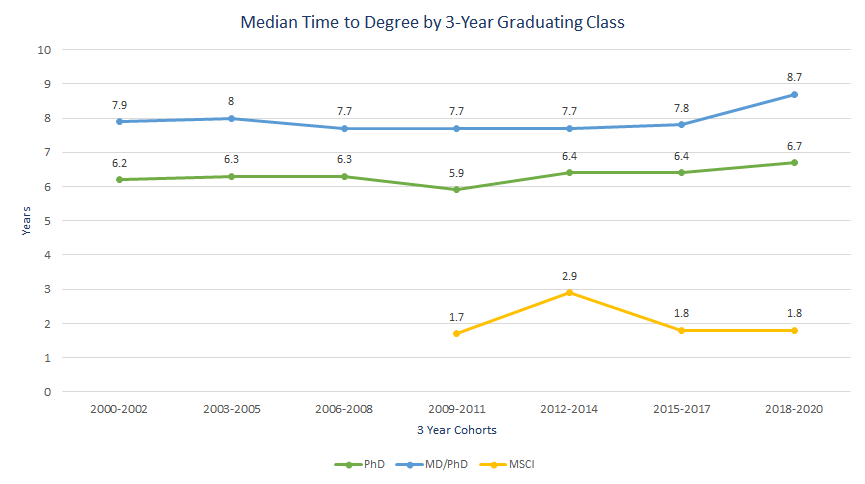
A line chart titled ‘Median Time to Degree by 3‑Year Graduating Class 2000–2020.’ It displays median time to degree, in years, for three programs—PhD, MD/PhD, and MSCI—across seven 3‑year graduating cohorts. PhD median time to degree:  2000–2002: 6.2 years 2003–2005: 6.3 years 2006–2008: 6.3 years 2009–2011: 5.9 years 2012–2014: 6.4 years 2015–2017: 6.4 years 2018–2020: 6.7 years  MD/PhD median time to degree:  2000–2002: 7.9 years 2003–2005: 8.0 years 2006–2008: 7.7 years 2009–2011: 7.7 years 2012–2014: 7.7 years 2015–2017: 7.8 years 2018–2020: 8.7 years  MSCI median time to degree:  2009–2011: 1.7 years 2012–2014: 2.9 years 2015–2017: 1.8 years 2018–2020: 1.8 years  Overall, MD/PhD students consistently require the most time to complete their degree, PhD students take about six to seven years, and MSCI students take under three years. Trends remain steady across cohorts with slight increases in the most recent years.

PhD Median Time to Degree 2000-2020
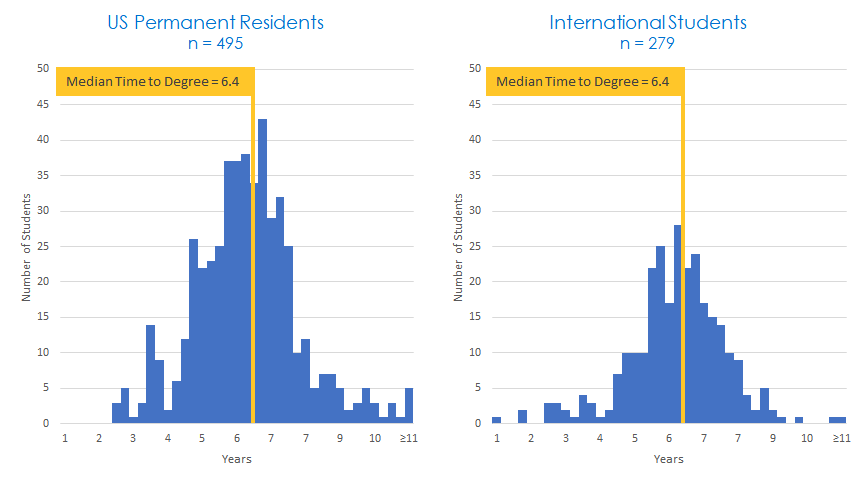
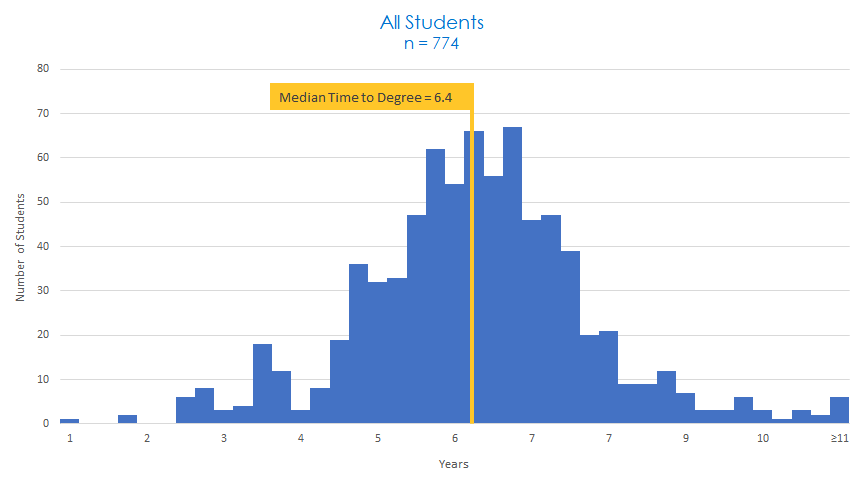
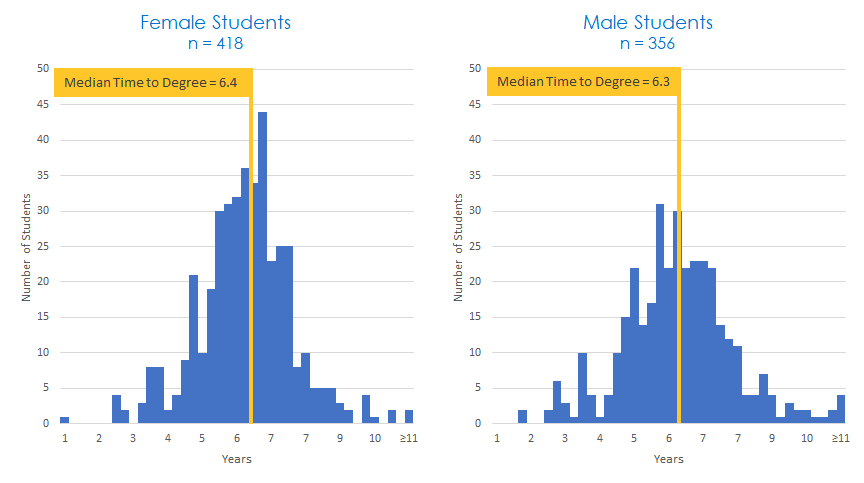
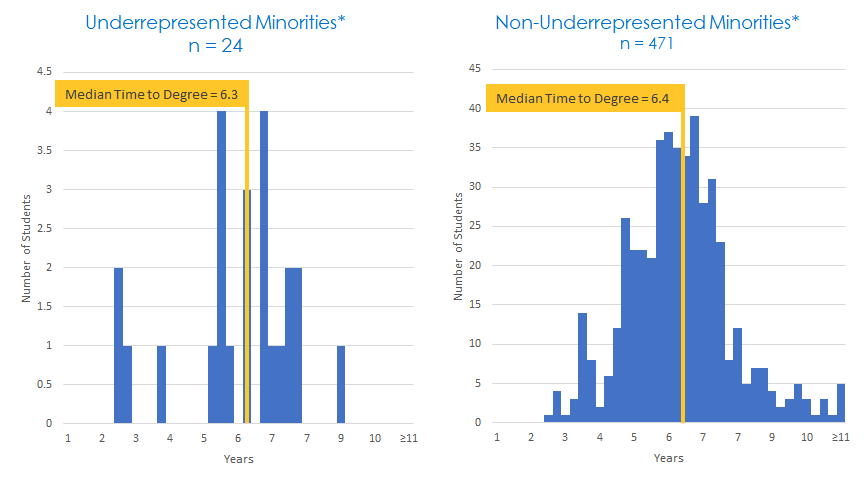
A histogram titled ‘PhD Median Time to Degree 2000–2020’ shows the distribution of time to degree, in years, for 774 PhD students. The x‑axis displays years to degree ranging from 1 to 11 years, and the y‑axis shows the number of students. Most students graduate between 5 and 7 years. The tallest bars, representing about 60 to 70 students each, fall between 6.0 and 6.5 years. A vertical yellow line marks the median time to degree at 6.4 years. Few students finish in under 3 years or over 9 years, with very small counts at the extremes.Two side‑by‑side histograms compare the distribution of time to degree for PhD students by gender. The left chart shows female students (n = 418) and the right shows male students (n = 356). For female students, the histogram shows most times to degree falling between 5 and 7 years. The tallest bars, reaching about 40–45 students, are just above 6 years. A vertical yellow line marks the median time to degree at 6.4 years. Very few students complete in under 3 years or more than 9 years. For male students, the distribution is similar, with most students finishing between 5 and 7 years. The highest bars, around 25–30 students, occur slightly above 6 years. A vertical yellow line marks the median at 6.3 years. As with female students, very small numbers appear at the extremes below 3 years or above 9 years. Overall, the two groups show similar patterns, with nearly identical median times to degreeTwo side‑by‑side histograms compare the distribution of PhD time to degree for U.S. Permanent Residents and International Students. The left chart represents U.S. Permanent Residents (n = 495) and the right chart represents International Students (n = 279). For U.S. Permanent Residents, most students complete their degree between 5 and 7 years. The tallest bars, reaching around 40–45 students, occur just above 6 years. A vertical yellow line marks the median time to degree at 6.4 years. Very few students finish in fewer than 3 years or more than 9 years. For International Students, the distribution is similar. Most students also graduate between 5 and 7 years, with the highest bars—about 25–30 students—just above 6 years. A vertical yellow line marks the median time to degree at 6.4 years, identical to U.S. Permanent Residents. As with the first group, only small numbers appear at the low and high extremes. Overall, both groups show nearly identical time‑to‑degree patterns and the same median of 6.4 yearsTwo side‑by‑side histograms compare time to degree for PhD students classified as underrepresented minorities (URM) and non‑underrepresented minorities (non‑URM). International students are excluded from these groups. The left histogram shows underrepresented minority students (n = 24). Most students complete their degrees between 5 and 7 years. A vertical yellow line marks the median time to degree at 6.3 years. The bars show a small, variable distribution due to the small cohort size, with only a few students in each time‑to‑degree interval. The right histogram shows non‑underrepresented minority students (n = 471). Most students complete their degrees between 5 and 7 years, with the tallest bars reaching around 35–40 students near the 6‑year mark. A vertical yellow line marks the median time to degree at 6.4 years. Very few students finish in fewer than 3 years or more than 9 years. Overall, both groups show similar time‑to‑degree patterns, with medians differing only slightly: 6.3 years for URM students and 6.4 years for non‑URM students
*International students are excluded from the URM data.  US Citizens and Permanent Residents only.

MD/PhD Median Time to Degree 2000-2020
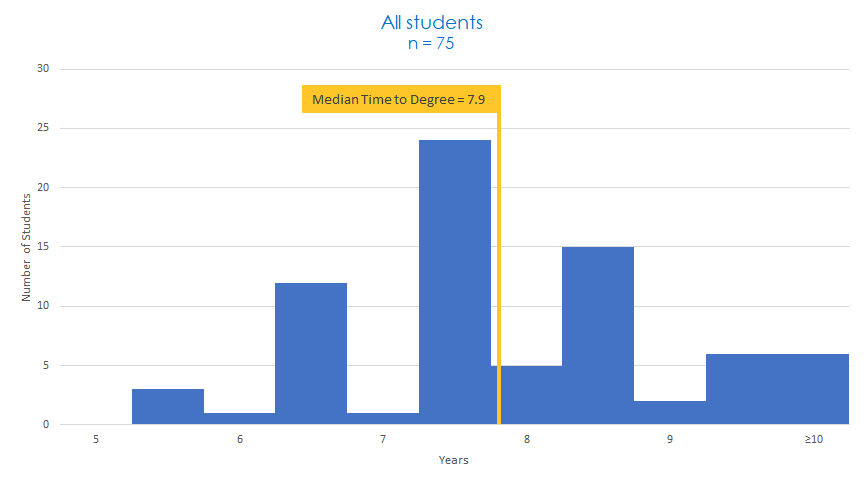
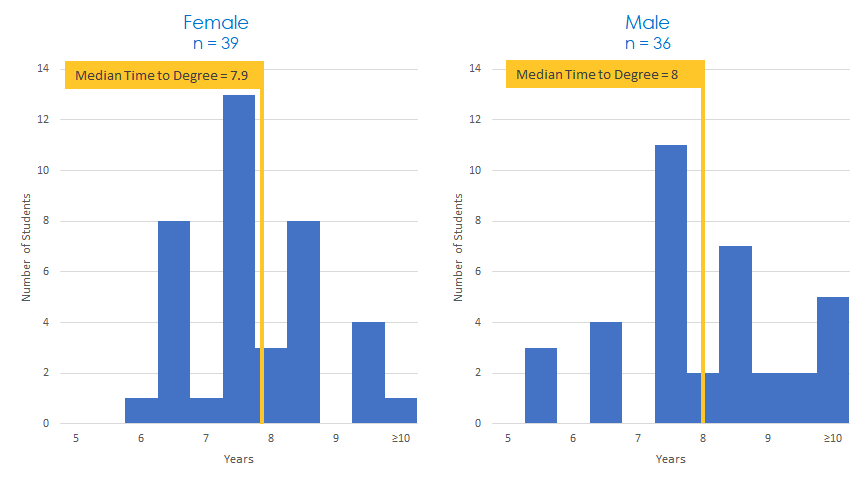
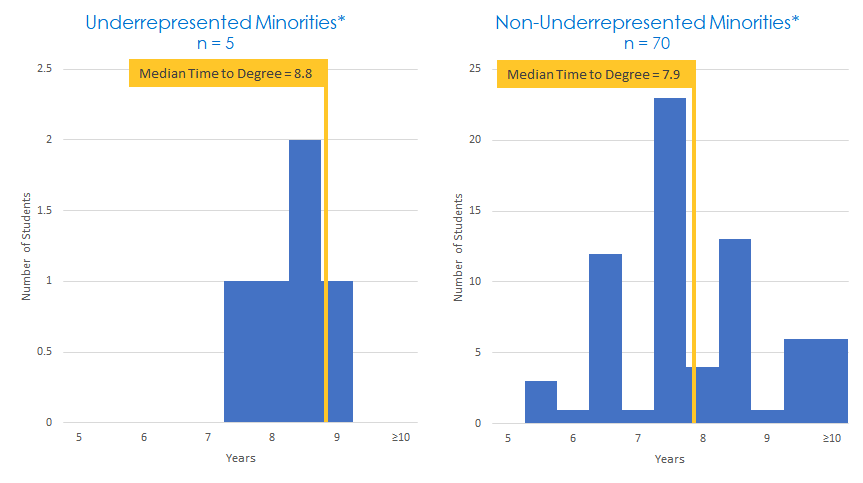
A histogram titled ‘MD/PhD Median Time to Degree 2000–2020’ shows the distribution of time to degree, in years, for 75 MD/PhD students. The x‑axis ranges from 5 to 10 or more years, and the y‑axis shows the number of students. Most students complete their degrees between 7 and 9 years. The tallest bar, representing about 25 students, is centered just below 8 years. A vertical yellow line marks the median time to degree at 7.9 years. Smaller numbers of students finish in the lower range around 5 to 6 years or in the upper range of 9 to 10 or more years.Two side‑by‑side histograms compare MD/PhD student time to degree by gender. The left histogram shows female students (n = 39), and the right shows male students (n = 36). For female MD/PhD students, most degree completion times cluster between 6.5 and 9 years. The tallest bar, with about 13–14 students, is centered slightly below 8 years. A vertical yellow line marks the median time to degree at 7.9 years. A small number of students finish earlier than 6 years or take 10 or more years. For male MD/PhD students, the distribution is similar but slightly shifted. Most students complete between 7 and 9.5 years. The tallest bar, with about 11 students, appears just before 8 years. A vertical yellow line marks the median time to degree at 8.0 years. A few students finish earlier than 6 years or take 10 or more years. Overall, both groups show similar patterns, with male students having a slightly higher median time to degree than female students.Two side‑by‑side histograms compare MD/PhD student time to degree for underrepresented minorities (URM) and non‑underrepresented minorities (non‑URM). International students are excluded from the URM data. The left histogram represents underrepresented minority students (n = 5). The distribution is small and concentrated between 7.5 and 9.5 years. The tallest bar reaches about two to three students near 8.5 years. A vertical yellow line marks the median time to degree at 8.8 years. The right histogram represents non‑underrepresented minority students (n = 70). Most students finish between 7 and 9 years. The tallest bar, around 22–24 students, is centered slightly above 7.5 years. A vertical yellow line marks the median time to degree at 7.9 years. Smaller numbers of students complete in under 6 years or in 10 or more years. Overall, URM students show a slightly higher median time to degree than non‑URM students, though the URM sample size is much smaller.

*International students are excluded from the URM data.  US Citizens and Permanent Residents only.