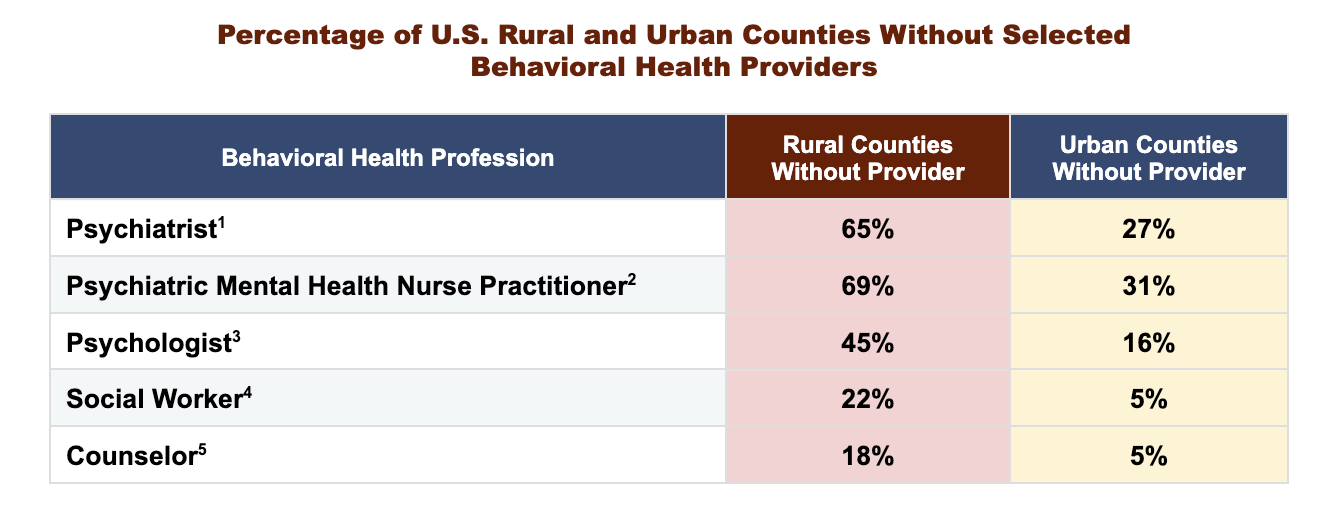
The Center for Integrated Primary Care (CIPC) is excited to announce that we have joined the National Rural Health Association (NRHA) as a nonprofit partner. This partnership reflects our ongoing commitment to strengthening the primary care workforce and expanding access to high-quality, integrated behavioral health care in rural communities. Rural primary care clinicians often serve as the front line for addressing the needs of patients with mental health conditions and substance use disorders, frequently with limited access to specialty behavioral health services. Our collaboration comes at a critical time: rural counties across the U.S. continue to face steep, persistent gaps in access to behavioral health care, as the data below make clear.
Rural primary care teams are asked to meet increasingly complex behavioral health needs while navigating workforce shortages and constrained resources. Preparing clinicians for demands of rural practice requires meaningful investment in workforce development alongside the financial, operational, and policy supports, and community partnerships that enable rural practices to thrive. CIPC is pleased to contribute to this effort through evidence-based education designed specifically for primary care settings.
Our educational offerings that are especially relevant to rural health teams include:
Advanced Mental Health Care in Primary Care: Equips primary care clinicians with practical, evidence-based skills to assess and manage common mental health conditions, substance use disorders, and behavioral health concerns within the primary care setting.
Certificate of Intensive Training inMotivational Interviewing: Builds clinicians' skills in partnering with patients to support meaningful behavior change, improve engagement, and address chronic disease management, substance use, and other health-related behaviors.
We look forward to partnering with NRHA and rural health leaders across the country to support the clinicians who are providing comprehensive, whole-person care in communities where it is needed most.
Sources:
Andrilla CHA, Patterson DG, Garberson LA, Coulthard C, Larson EH. Geographic variation in the supply of selected behavioral health providers. Am J Prev Med. 2018;54(6 Suppl 3):S199-S207. doi:10.1016/j.amepre.2018.01.004.
National Center for Health Workforce Analysis. State of the Behavioral Health Workforce, 2025. U.S. Department of Health and Human Services, Health Resources and Services Administration; December 2025.