

Photo courtesy of Kathryn Sabella
A UMass Chan Medical School researcher is hoping to shed light on the social causes of increased alcohol use among women, with the goal of reducing stigma and advocating for societal changes.
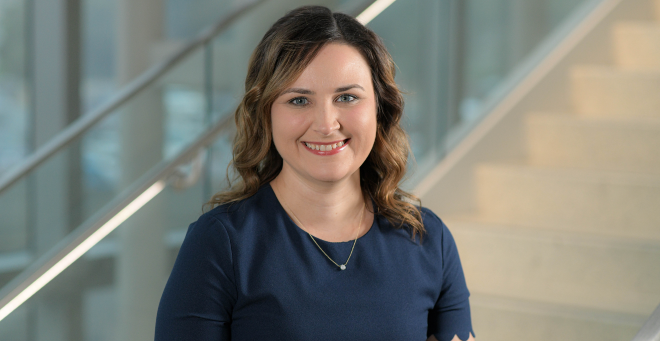
Kathryn Sabella, PhD, assistant professor of psychiatry & behavioral sciences and director of the Transitions to Adulthood Center for Research in the Implementation Science and Practice Advances Research Center, (iSPARC), was awarded a highly competitive grant from the National Institute on Alcohol Abuse and Alcoholism (NIAAA) to study factors contributing to the narrowing gap in binge drinking between women and men.
Dr. Sabella will conduct a secondary analysis of data from the National Longitudinal Study of Adolescent to Adult Health to assess how factors like age, race/ethnicity, income, stress and social roles influence men’s and women’s drinking habits in young adulthood (ages 24-32) and middle age (ages 39-52). Sabella hypothesizes that the occupation of multiple social roles, symptoms of depression and anxiety, and stress uniquely influence excessive alcohol use, like binge drinking among women, compared to men.
“I’m hoping to reveal some of the factors that are differentially contributing to increased alcohol use among women across the lifespan that might not be contributing to alcohol use among men. My goal is to identify some of the social causes of excessive drinking among women and inform social, systematic and policy changes that may ultimately reduce rates of excessive alcohol use among women,” Sabella said.
Over the past 20 years, according to the NIAAA, the gap between men and women for excessive alcohol use, alcohol-related illness and death has narrowed significantly. Between 2000 and 2016, alcohol use and binge drinking rose among women but remained stable among men. During the COVID-19 pandemic, women also showed a notable increase in heavy drinking days, while men did not.
As a woman in recovery from alcohol use disorder, Sabella said the project is motivated by her own personal recovery journey and the women she’s met along the way. Women in recovery, especially mothers, describe turning to alcohol to cope with the modern stressors of motherhood while juggling full-time employment, marriage and caretaking, she said.
“All people with substance use disorders experience some form of discrimination, but society is especially harsh on women and mothers who struggle with substance use. If I can shed light on how societal patterns and stressors shape these experiences, it can help women feel less shame and stigma,” Sabella said.
Lourah Kelly, PhD, assistant professor of psychiatry & behavioral sciences, is a co-investigator on the study. Sharina Person, PhD, professor of population & quantitative health sciences, is working with Sabella to advise on statistical analysis.