
At a glance |
|---|
|
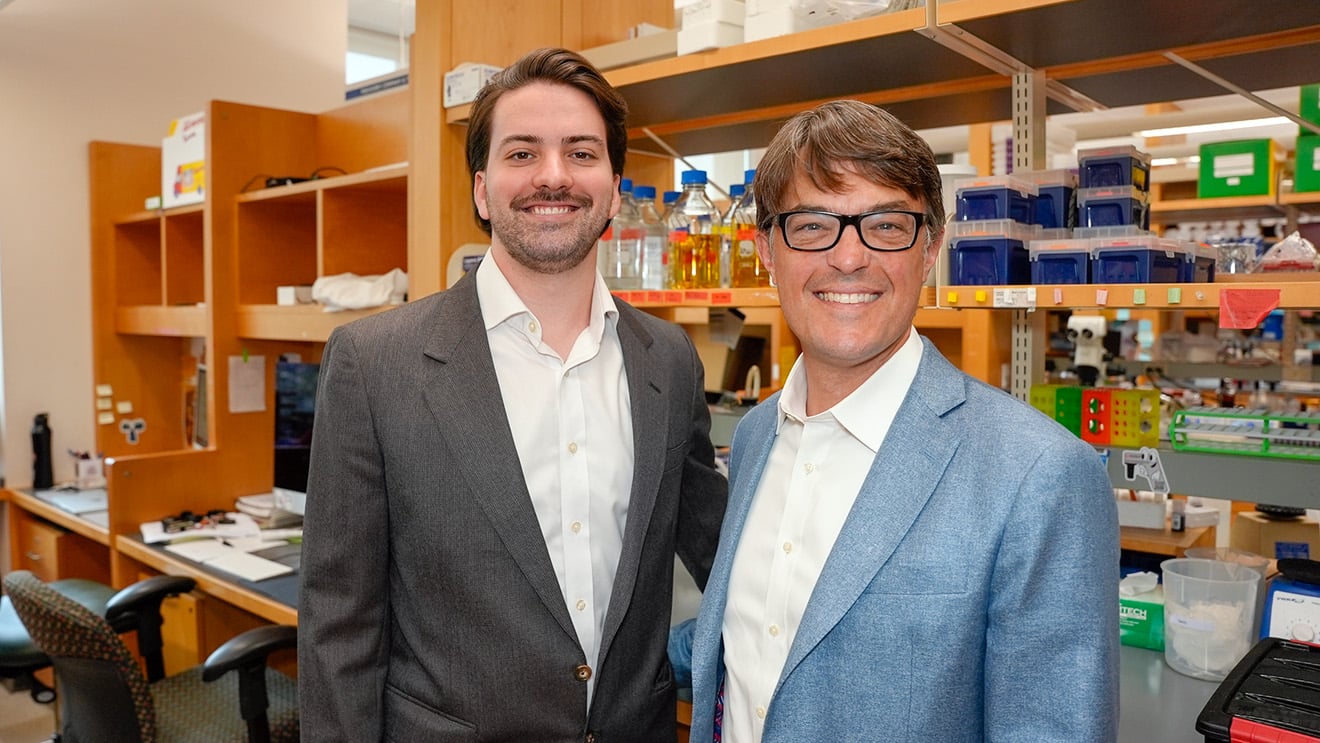
Photo: Hallie Leo
Noah Sciambra, MS, an MD/PhD student in the Medical Scientist Training Program (MSTP) at UMass Chan Medical School, has received a prestigious Ruth L. Kirschstein National Research Service Award from the National Institute of Allergy and Infectious Diseases to investigate how natural genetic differences influence a host’s ability to resist toxins produced by the bacterial pathogen Pseudomonas aeruginosa.
P. aeruginosa is a gram-negative bacterium that can cause serious infections, particularly in people who are hospitalized or immuno-compromised. The severity of these infections can vary dramatically from one individual to another, yet genetic factors that contribute to these differences are not well understood.
Working in the lab of Read Pukkila-Worley, MD, professor of medicine and director of the MSTP, Sciambra uses the model organism C. elegans to investigate how genetic differences influence host resistance to bacterial pathogens.
C. elegans naturally encounter P. aeruginosa in the wild. Yet, individual C. elegans vary widely in their susceptibility to the toxins produced by the bacteria. The genetic diversity underlying these differences can be studied for their contributions to bacterial toxin resistance.
“We can take genetically different populations of C. elegans found around the world, whose entire genomes have been sequenced, expose them to the same bacterial toxins, and observe striking differences in how well they survive,” Sciambra said. “Because we know their genetic makeup, we can then examine which naturally occurring genetic differences are responsible for resistance and determine how those genes protect the host.”
Sciambra has identified a small region of the C. elegans genome that plays an important role in determining resistance to P. aeruginosa phenazine toxins and how well an animal survives the bacterial threat. He is now working to pinpoint the genetic differences within this region that are responsible for resistance.
“Noah is an outstanding student and a joy to have in my lab,” said Dr. Pukkila-Worley. “The project funded by this grant was his idea, which was informed by his research experiences prior to matriculating at UMass Chan. I’m very proud of him and this important achievement.”
Sciambra developed an early interest in science and medicine that was strengthened by mentors in high school and college. He emphasized that community is what initially attracted him to UMass Chan.
“What I love about UMass Chan is the people,” he said. “Everyone is kind and collaborative, and I’ve found so many people who are incredibly supportive and want to see me succeed. Coming from New Orleans, I’ve been pleasantly surprised by how diverse and welcoming Worcester is. It’s been great to be here for the past five years and to see the campus continue to grow.”
Outside of the hospital and lab, Sciambra loves spending time with his wife and fellow MSTP and MD/PhD student Rebecca Panwala-Sciambra and their cats. He also enjoys playing basketball, running, rollerblading and playing video games.
Sciambra hopes to pursue a career as a physician-scientist, caring for patients while conducting research that informs the understanding and treatment of their diseases. He is considering specializing in allergy and immunology or infectious diseases.