
Photos: Pat Sargent
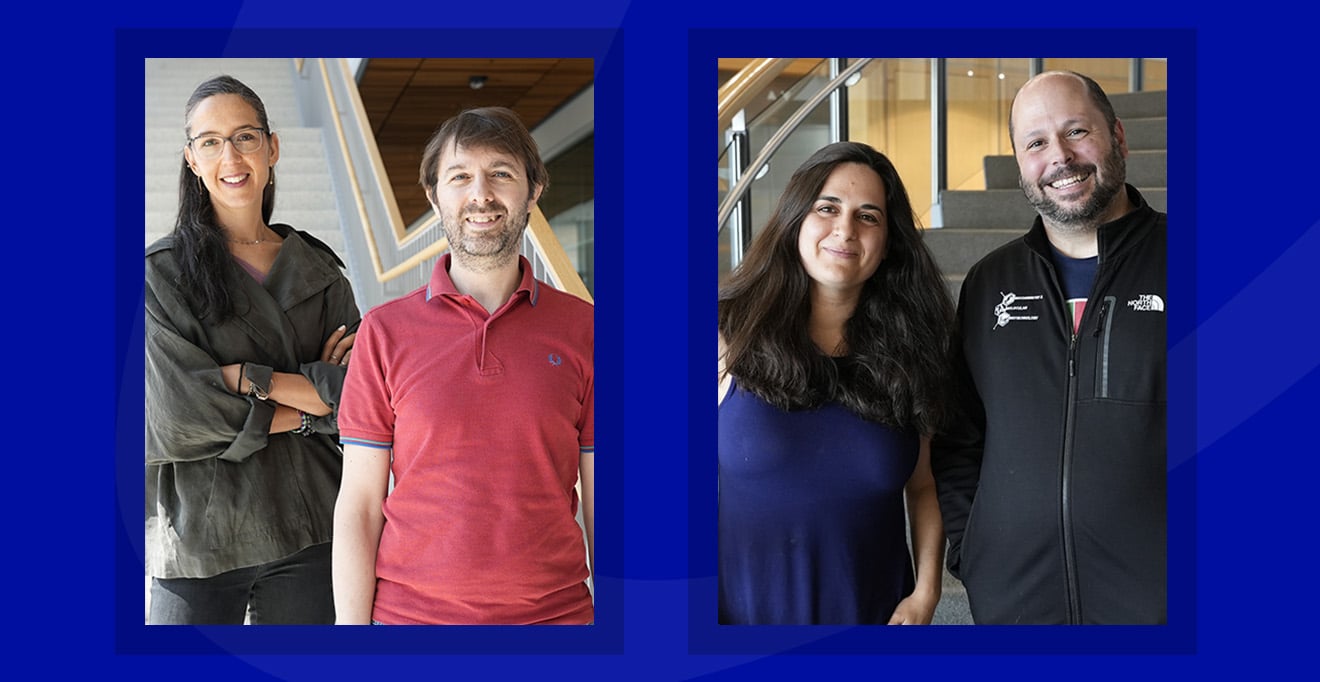
Two interdisciplinary teams of UMass Chan Medical School scientists were awarded $45,000 each from the Dan and Diane Riccio Fund for Neuroscience for research in pain management and long-term memory storage.
“This award is a classic example of putting together people from different domains to move research forward in unexpected directions,” Andrea Reboldi, PhD, associate professor of pathology, said. “It’s great that the Riccio family is funding research that supports collaborations across departments.”
Brian Kelch, PhD, professor of biochemistry & molecular biotechnology, said, “We really appreciate this award. The generous contributions of the Riccio family have supported several innovative scientific discoveries at UMass Chan. Their commitment to high risk, high reward neuroscience research makes projects like ours possible.”
Combating opioid tolerance
Dr. Reboldi, an immunologist, and neurobiologist Stephanie Puig, PhD, MS, assistant professor of psychiatry & behavioral sciences, will study the involvement of immune cells in the mechanism of peripheral opioid tolerance—the phenomenon that leads peripherally delivered opioids to become less effective over time.
Previous research by Dr. Puig identified that the presence of the platelet-derived growth factor (PDGF) signaling protein, which plays an important role in cell growth and wound healing, also contributes to the decreased ability of morphine to relieve pain over time. Together, Puig and Reboldi will investigate if the source of the PDGF signaling protein in this situation could be the macrophage immune cell.
“We found that morphine triggers the release of the signaling protein PDGF,” said Puig. “However, when PDGF is blocked while administering morphine, we’re able to preserve the pain killing effect of the drug permanently.
“This research could potentially help with the ongoing opioid crisis. If we can locate the source of the PDGF and block it, patients wouldn’t need escalating doses of opioids to maintain long term pain relief, which often leads to deleterious side-effects and addiction in chronic pain patients.”
The award supports PhD students Anita Khasnavis and Emily McNaughton in the Puig and Reboldi labs, respectively.
Studying the staying power of memories
Dr. Kelch and Summer Thyme, PhD, associate professor of biochemistry & molecular biotechnology, are researching how memories are stored in brain cells at a molecular level. Using zebrafish models and behavioral tests for memory, the pair aim to understand how memories are passed from one generation of molecules to the next.
The Kelch lab specializes in structural biology and is developing cryo-electron tomography techniques to visualize molecules physically at near-atomic resolution. Meanwhile, the Thyme lab studies how the nervous system and brain work in zebrafish in an effort to develop treatments for neurodevelopmental disorders.
“Zebrafish are ideal for this work because they’re very small and transparent and capable of forming memories,” Dr. Thyme said. “This funding will allow us to study whether proteins responsible for storing memories form a large cluster, called an oligomer, with copies of themselves. The cluster remains intact by continuously replacing protein molecules. This allows the cluster to persist at the synapse for long periods and preserve long-term memories.”
The Riccio Fund was established in 2017 with a $1 million donation from the Riccio family. In 2022, the Riccio family donated an additional $15 million to UMass Chan, including $5 million to endow the Dan and Diane Riccio Fund for Neuroscience.