

Coaching and Individualized Education
Our program is hugely invested in each of our residents - we feel so fortunate to help advance your training. Three years flies by (truly) so we want to maximize our time together. We acknowledge that the tools you each have learned prior to residency can vary. Our coaching program aims to smooth out those differences, reinforce and practice necessary skills, and make sure the foundation is solid for all. We initiated this coaching program in the spring of 2026... feedback wanted!
Herein, we also take the opportunity to describe other ways in which our residency supports residents. Individualized Education Plans (IEPs) can be viewed as blueprints for coaching. They describe opportunities for skill and/or knowledge development and actions to promote that development. IEPs should not be confused with Corrective Action Plans (CAPs) which are more formal education plans requiring extra resources and that need to be achieved on a specific timeline. The goal is always the same: train our residents in a caring and supportive manner to become successful pediatricians and advocates for children.
- Coaching
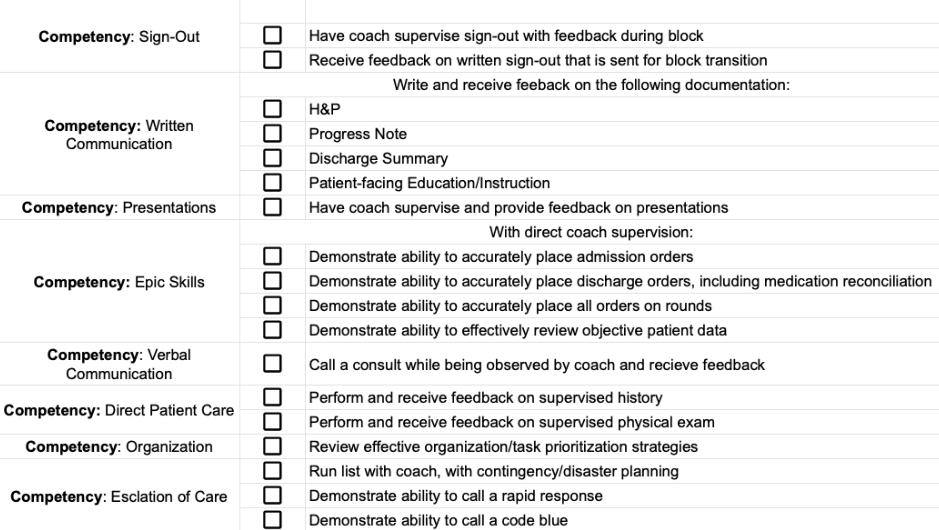
- All residents will experience coaching during their intern year. Much of this program is administered by the chiefs - they will catch you on various rotations and make their way down a standard list of tasks. Here's a basic template of items that may be covered:
-
- The chiefs will give you feedback in the moment and also keep a log of how things go. Feel free to personalize this training - tell them what is easier, harder, what could use extra practice.
- As we iron this out - you may be paired with a senior resident or faculty for some items. No fear - that's just us learning as we go, figuring out who is the right coach for the various skills.
- We hope this program is fun and useful. With these skills solidified, you'll be ready for senioring! In fact, we may even add some senioring skills to the coaching list as we further develop this program.
- Individualized Education Plans - IEPs
- While implementing coaching, and as residency rolls along, it is common for residents to have a couple of areas that would benefit from advanced focus and practice in the form of an IEP. These are every year occurrences (multiple!) and do not imply anything beyond that - it is simply extra energy input to boost foundational skills.
- When we identify these areas, the Residency Leadership team preps a document describing the areas for targeted skill development and a plan of action. We welcome resident input, as gaps can come from a wide differential of concerns (from lack of prior experience to fatigue to anxiety and more). We often utilize resources at the Center for Academic Achievement. Examples of IEP items can include:
- If fund of knowledge is below expected, we may recommend study/teaching time. This gives time to review topics and prep chalk talks, for example. We may suggest board prep questions or supplemental online work. All is tailored to the need.
- If efficiency or organization is tricky, we may suggest extra time with a coach, either on an elective or a service block: someone at arm's length to assess your current methods and provide in-the-moment tips and role modeling. We may suggest specific activities with a faculty member or chief. Again - all is tailored to the individual's need.
- IEPs tend to last over several months - there is no single timeline. This gives time for the plan to be enacted, time to reassess progress, time to experience rotations where specific skills are utilized more or less.
- To reiterate - we anticipate enacting several IEPs each year as a method of targeted education. They are not punitive. They do not imply any sort of "failing." They should not induce fear nor shame. Our goal is to walk purposely through your training together!
- Corrective Action Plans - CAPs
- At times, we identify residents who seem to be stuck in terms of progressing specific important residency skills or perhaps may exhibit concerning professionalism patterns. A CAP outlines these concerns. This can feel isolating and upsetting. For us - we see this as part of the spectrum of needed support and we are honored to provide this support as kindly, efficiently, and clearly as we can.
- In the case of a CAP, the Residency Leadership team preps a document that describes identified gaps, a plan of action, and also an expected timeline of reassessment. A union rep is invited to ensure a fair discussion, as CAPs typically have some consequences attached to the outcome. For example, some barriers to skill development might require an extension of training to get the resident what they need (see below). Together, we sign the document once it is fully agreed upon.
- CAPs are a formal process across all residencies - therefore, Graduate Medical Education (GME) and our residency's Clinical Competency Committee (CCC) are aware of all CAPs and help guide the process.
- If CAP goals are not met, there can be consideration to modify or extend the CAP, or extend residency training. Terminating training is an exceedingly rare and unusual outcome.
- As we have noted - our Residency Leadership's focus is 100% on our residents’ success. We are committed to supporting a successful learning environment. CAPs are a way to compile extra input, time, resources, and focus with the ultimate goal of successful residency completion.