
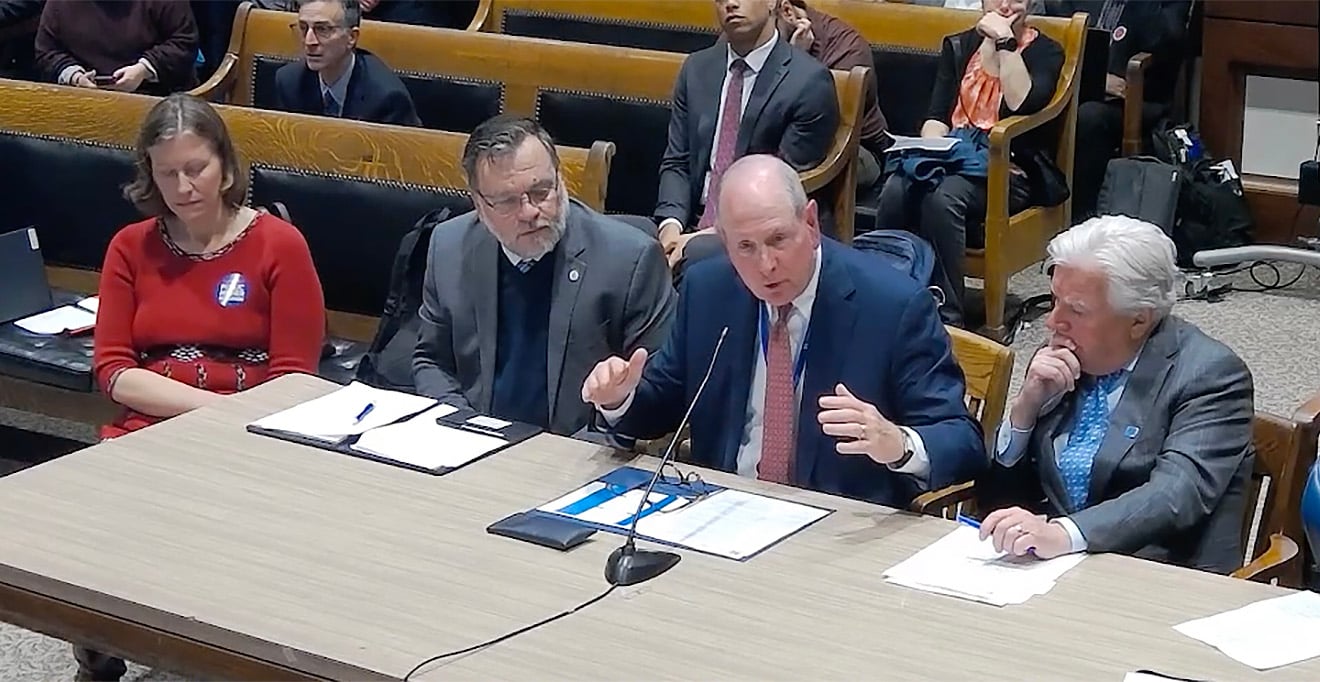
Photo: From livestream of 10-30-25 DRIVE public hearing
UMass Chan Medical School Chancellor Michael F. Collins says changes to the National Institutes of Health (NIH) funding mechanism threaten the nation’s biomedical research infrastructure and undermine clinical advances being made on treating diseases from cancer and diabetes to Alzheimer’s.
“NIH funding changes the course of history of disease and this is no time for the finest biomedical research enterprise on earth to withdraw from that worthy objective,” Chancellor Collins said in a Feb. 5 Boston Globe story. “Research brings hope to the human condition.”
Additionally, an editorial in the Feb. 5 Boston Globe includes comments from Collins and explains how federal funding changes have impacted UMass Chan, such as by shrinking the size of its PhD class.
“The overall solution, of course, is for the Trump administration to stop these senseless cuts,” the Boston Globe editorial board said in the piece.
Collins was also quoted in Politico, just as President Donald Trump signed into law legislation providing $48.7 billion in funding to the NIH for 2026, a 1 percent increase over the previous year. This is $20 billion more than was proposed in the Trump budget released last year. The law also contains language that protects indirect costs on grants from being capped at 15 percent, a move the Trump administration tried to impose last spring.
While the NIH budget overall has increased slightly, other potential changes that harm the country’s biomedical research hubs remain. The NIH, for instance, has rerouted millions of dollars of discretionary funds and studies on health disparities related to race or gender have been cancelled. And the NIH has signaled a willingness to redirect federal funds away from biomedical research centers that have taken decades to establish to universities in that lack the infrastructure to support intensive scientific research. NIH Director Jay Bhattacharya, PhD, has also proposed breaking the link between direct support that covers the cost of research and indirect costs that cover the cost of infrastructure and facility support. However, the research can’t happen without the appropriate infrastructure.
“To suggest that it’s simple to take the money and distribute it on geographic balance doesn’t recognize the importance of the investment that has been made over six or seven decades,” Collins told Politico.
Collins told the Boston Globe how funding declines and uncertainty have hampered the Medical School’s ability to admit and train new PhD students. In fiscal 2025, for instance, UMass Chan received 345 awards from the NIH, the fewest in the past five years, for a total of $190.4 million. While this amounts to just 1.6 percent less than in fiscal 2024, because of a change in how the Trump administration is distributing multiyear grants, $13.2 million of that can’t be used this year. The negative impact on training new scientists is huge. In reaction to federal funding uncertainties last spring, UMass Chan reduced the size of its incoming 2025 PhD class to 13 students, down from 73 students in the 2024 class. The size of the 2026 class will be larger than this year but still reduced from typical years due to the federal funding cuts, Collins said.
“If fewer labs are funded, there are fewer opportunities for graduate students,” Collins said. “I’m not happy with it. I hope we can get to a point of more steady funding, but I don’t see it in the next short period of time.”
On the state level, Collins and others are advocating in favor of Gov. Maura Healey’s Discovery, Research and Innovation for a Vibrant Economy (DRIVE) legislation. Gov. Healey introduced the $400 million DRIVE initiative to grow the commonwealth’s research and innovation economy and create thousands of new jobs last fall. The initiative would help the Medical School offset approximately $30 million in federal research funding that has been stalled.
“This legislation would allow the Medical School’s world-class faculty to continue lifesaving research programs that have been threatened by federal funding cuts and uncertainty,” said Collins.