Photo: Bryan Goodchild
A special announcement from Massachusetts Gov. Maura Healey on Thursday, July 31, will have a direct impact on the availability of funds for future research programs at UMass Chan Medical School.
At a press conference at the Massachusetts State House, Healey introduced Discovery, Research & Innovation for a Vibrant Economy (DRIVE) initiative, a $400 million strategy to grow the commonwealth’s research and innovation economy and create thousands of new jobs in the face of federal funding cuts.
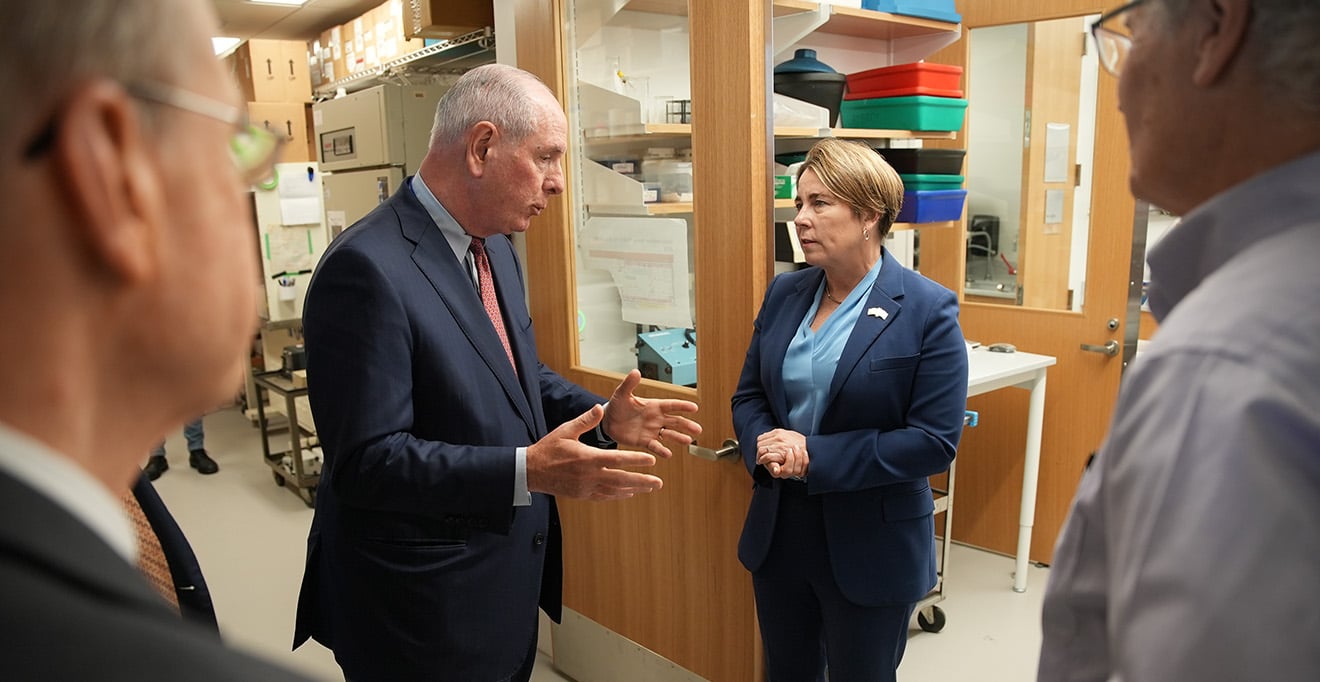
“This is an investment in talent and research and know-how and innovation. This is an investment in an industry partnership at our public state colleges and universities. This is also going to create a mechanism for pulling in public and private investment,” Healey said. “This is truly a team-Massachusetts effort. We’re bringing together leaders from research, education and industry to develop a long-term strategy for our state.”
At a glance |
|---|
|
Roughly half of the state funding in Healey’s proposed legislation will go to a multiyear research funding pool at MassDevelopment to support research projects at hospitals, universities and independent research institutions. The other half will be placed into a higher education bridge funding reserve, funded by Fair Share surtax revenue, for public higher education campuses to cover direct and indirect costs of research, cross-regional partnerships and joint ventures.
“The governor’s proposed legislation to provide critical bridge funding for research both reflects and reinforces the commonwealth’s steadfast commitment to sustaining the promise of scientific discovery and the careers of researchers who devote their lives to generating new knowledge in furtherance of human health,” said UMass Chan Medical School Chancellor Michael F. Collins. “Undoubtedly, this investment will help retain exceptional talent, support ongoing critical research, and reinvigorate UMass Chan’s commitment to advancing the health and well-being of the communities we are privileged to serve.”
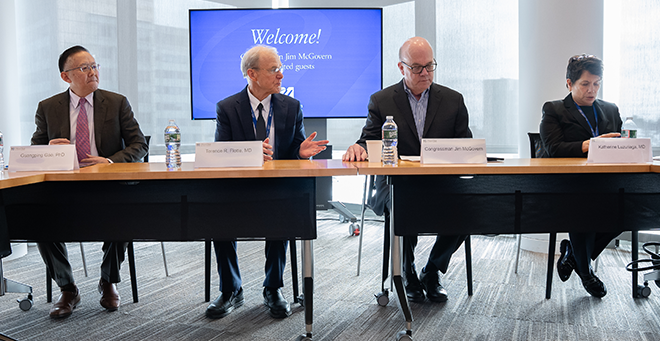
Healey was joined during the announcement by Lt. Gov. Kim Driscoll, cabinet members, state and elected officials, and representatives from higher education and research institutions, including UMass President Marty Meehan and Terence R. Flotte, MD, the Elisabeth Chair for the Dean of Medicine, executive deputy chancellor, provost and dean of the T.H. Chan School of Medicine.
“By standing up for research, innovation and jobs, this initiative will protect Massachusetts’ world-renowned research and innovation economy and ensure we continue to attract and retain the best and brightest talent,” said President Meehan.
During her remarks, Healey celebrated UMass Chan’s Nobel laureates—Craig C. Mello, Howard Hughes Medical Institute Investigator, the Blais University Chair in Molecular Medicine and distinguished professor of RNA therapeutics and molecular medicine; and Victor R. Ambros, PhD, the Silverman Chair in Natural Sciences and distinguished professor of molecular medicine—and praised the university’s groundbreaking research and innovative treatments for a wide range of diseases.
“UMass Chan . . . is a research powerhouse, a gem, an asset for the commonwealth,” Healey said.
UMass Chan, the state’s only public academic health sciences center, received $193 million in National Institutes of Health funding in 2024 but is now facing an approximately $60 million shortfall in NIH research funding, due to long delays in funding new grants since the Trump administration took office in January.
UMass Chan currently awaits funding notices for 64 grant submissions that have achieved fundable scores from the review process. That translates into a research budget variance of nearly $40 million this fiscal year and more than $176 million in total research funding over the life of those grants.
To make up for the shortfall and to prepare for federal funding uncertainty in the coming year, the incoming Morningside Graduate School of Biomedical Sciences class was significantly reduced, faculty recruitment has been paused, an estimated 200 employees have been furloughed or laid off, and hiring and discretionary spending has been frozen.
“Even as the Trump administration is following the letter of the law and distributing more funds, it’s decreasing the number of grants having an impact on biomedical research. I am very grateful to Gov. Healey and the state’s legislature for supporting this legislation, and to be part of a commonwealth that supports biomedical research,” said Dean Flotte.