
Photo: Bryan Goodchild
At a glance |
|---|
|
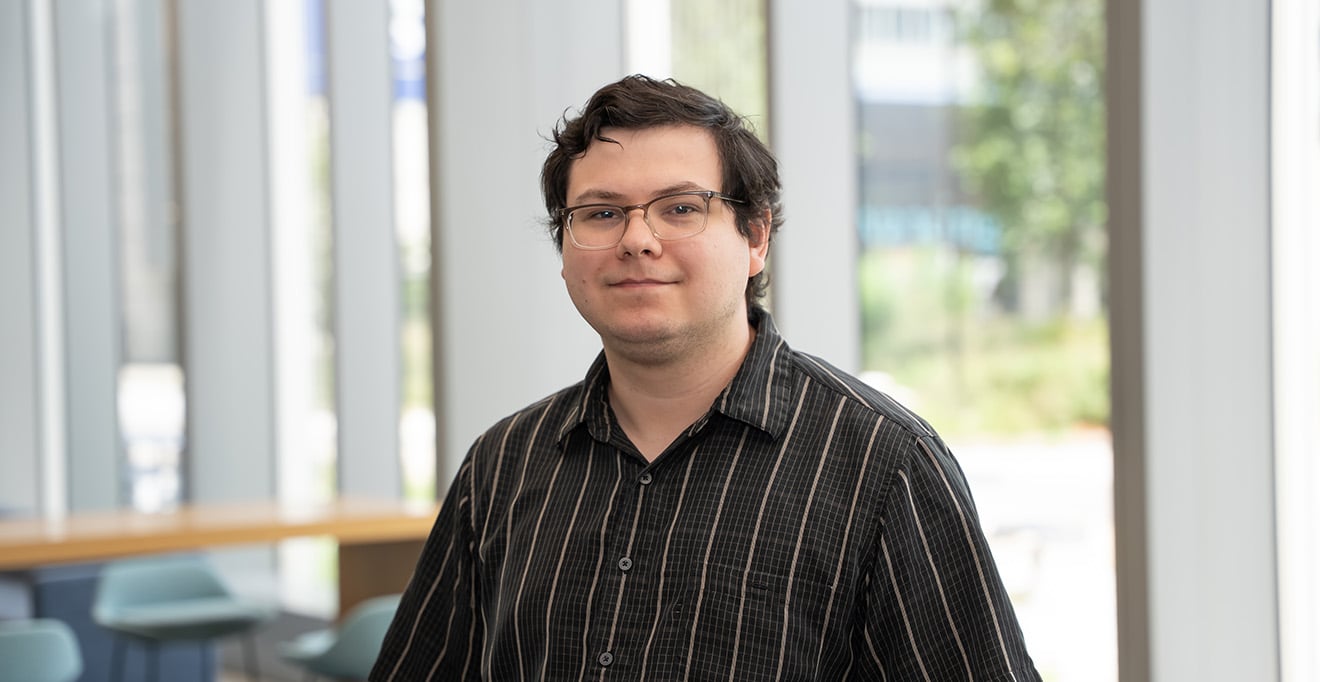
Postdoctoral fellow Brandon Bastien, PhD, is the recipient of a fellowship award from the National Institutes of Health (NIH) to support his work with zebrafish and research on genes linked to autism.
“The goal of the project is to use zebrafish to model how autism-associated genes shared between humans and zebrafish affect the brain and behavior, with the hopes of identifying potential targets for future therapies,” Dr. Bastien said. “This research could help us identify what kind of underlying changes go on in the brain, which can show us which drugs can be used to complement existing treatment strategies.”
One early research finding, for example, found that a particular autism-related gene nearly eliminates dopamine neurons in the zebrafish forebrain. Dopamine is a chemical messenger in the brain that supports learning and memory. Bastien is now exploring if manipulating dopamine signaling can be used as a treatment for impaired memory in the fish.
The NIH F32 award is for $251,000 over three years and will help Bastien toward his long-term goal of becoming an independent investigator.
“This award will help me take my research into modeling patient-specific mutations in zebrafish to better understand how different mutations can affect a single gene in different ways, like autism or schizophrenia or rare neurodevelopmental disorders,” Bastien said. “It’s going to allow me to build a foundation of genotypes that I can investigate further later on in my career.”
Bastien works in the lab of Summer Thyme, PhD, associate professor of biochemistry & molecular biotechnology, which uses zebrafish to understand how conserved genes are associated with neurodevelopmental disorders. He joined the lab in November 2024.
Bastien completed his PhD in neuroscience at the University of Pennsylvania in 2024 and earned his bachelor’s degree in neuroscience from Swarthmore College. He is originally from Orange County, California.