
Photo: Bryan Goodchild
Eviatar Yemini, PhD, assistant professor of neurobiology at UMass Chan Medical School, has received an AI Accelerator Seed Project Award from the UMass Amherst Center for Data Science and Artificial Intelligence (CDSAI) to develop novel computational algorithms that can detect and identify different neuron types from 3D images and recordings.
The technology will allow biomedical scientists to more easily study whole-brain activity in animal models of human neurological diseases. It is being designed by Dr. Yemini and UMass Amherst colleagues Ozgur Yilmazel, PhD, director of applied AI research and engagement at CDSAI and professor of information science; Anshita Gupta, MS, research fellow at the Manning College of Information & Computer Sciences; Swetha Saseendran, MS, software developer at CDSAI; and Taru Meshram, BS, a recent computer science graduate.
“We’re not just applying existing tools to a problem, we’re developing new ones,” said Yemini. “This award connects UMass Amherst’s cutting-edge AI and data science expertise with the fundamental biological questions we’re investigating at UMass Chan. This cross-campus collaboration means the AI methods are being built around basic biology. That kind of integration is rare, and it’s what moves both fields forward.”
C. elegans have analogous neuronal genes, proteins and neurotransmitters (like dopamine) to humans, which operate in a similar manner, making them an ideal model organism for studying gene functions, ageing and disease. To better understand how the 302 neurons in these microscopic transparent worms work together to promote health and disease, Yemini previously created NeuroPAL, a multicolored worm that employs a unique color barcode to identify every neuron in the worm’s brain. Using color and position, researchers can map brain activity to specific neurons in the worm. However, manually finding and accurately identifying individual neurons in tens to hundreds of 3D images remains a time-consuming process and can take months or years to complete. It also requires training and experience to map each color to its respective neuron. Automating the labor would condense this task to a few hours or days. This would allow investigators to map the brain functions of an entire family of genes and their mutations in a fraction of the time it currently takes.
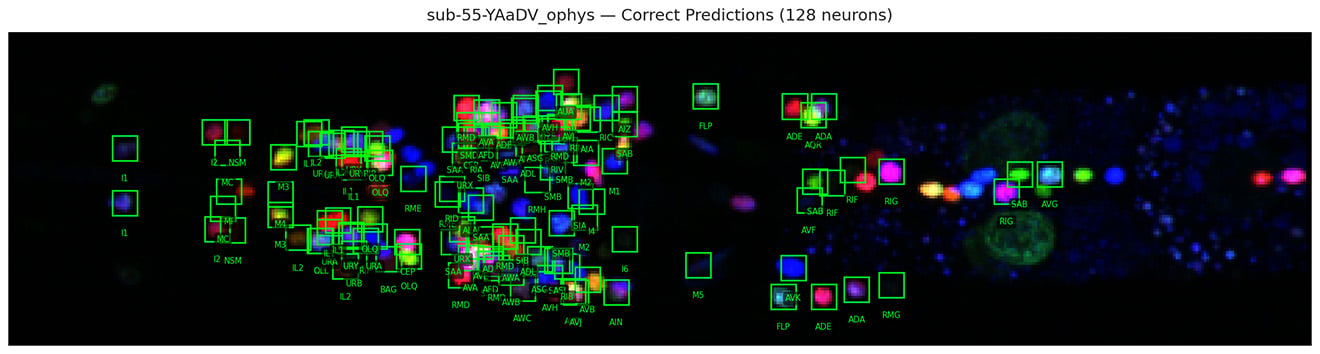
“This is exactly what the AI accelerator was built to do,” said Dr. Yilmazel. “By working closely with Dr. Yemini, we can help turn an early-stage research idea into working AI methods that can be applied to real biological questions. At CDSAI, our goal is to put applied AI engineering capacity directly behind researchers across UMass, so promising ideas can become working systems.”
Once completed, the new AI algorithms will be incorporated into the NeuroPAL ID software available from GitHub. Yemini and colleagues expect these algorithms will be used to connect specific brain activity with behaviors to better understand how the brain codes for behavioral actions in real-time.
“It’s inspiring to see the strengths of biomedical innovation at UMass Chan and AI expertise from UMass Amherst brought together in innovative ways,” said William K. Barnett, PhD, chief research computer officer and associate professor of systems biology. “I expect this will be one of many such collaborations between our two organizations as biomedical and computer science are brought together to advance human health together.”
Established in 2015, the Center for Data Science and Artificial Intelligence is part of the Robert and Donna Manning College of Information and Computer Sciences (CICS) at UMass Amherst. The AI Seed Funding project provides in-kind data science and AI technology support for research projects across University of Massachusetts campuses.