Photo: Bryan Goodchild
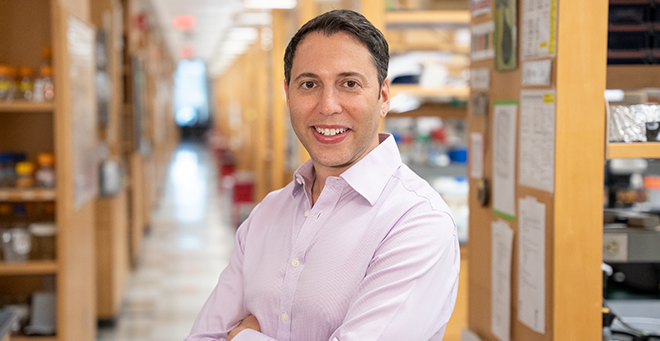
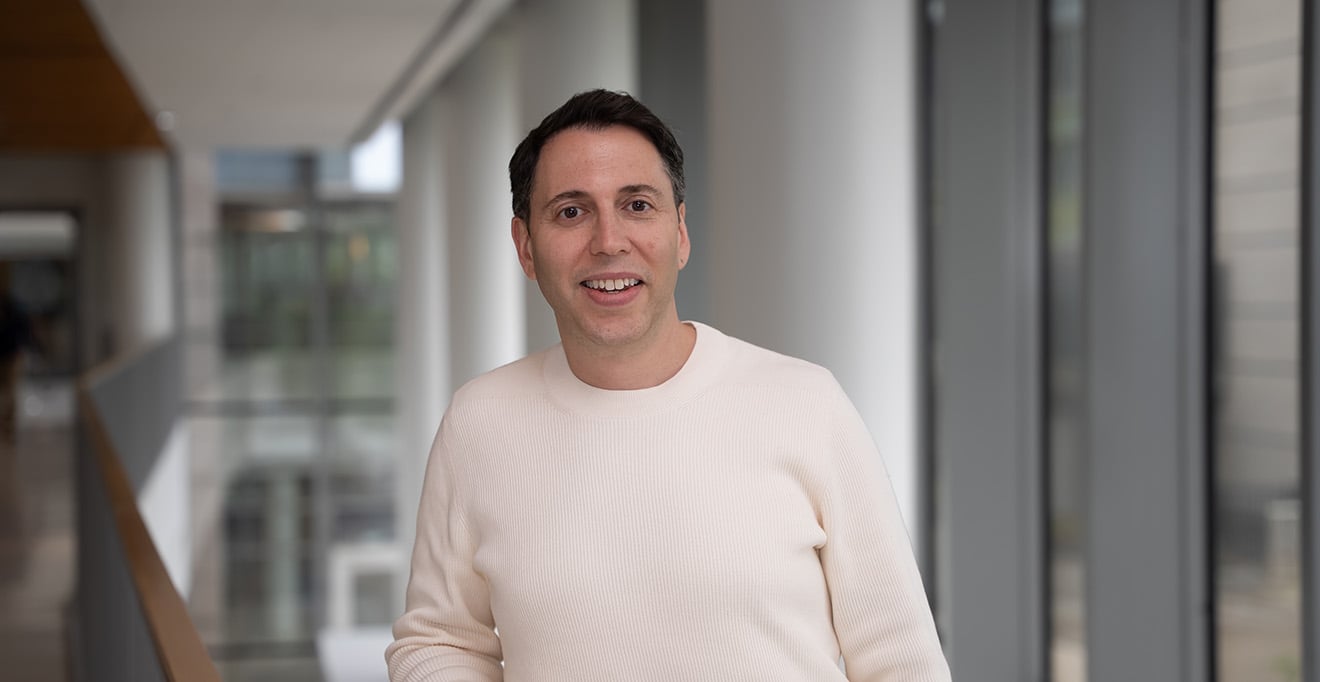
For the second consecutive year, Eviatar Yemini, PhD, assistant professor of neurobiology at UMass Chan Medical School, has received a Scialog Collaborative Innovation Award for a cross-disciplinary project advancing fundamental understanding of how neural systems adapt to today’s rapidly changing environment. The award is part of the three-year Scialog: Neurobiology and Changing Ecosystems initiative.
Dr. Yemini also won an award in 2025, the inaugural year of the initiative. He is one of approximately 50 early career faculty invited to participate in the program.
This year, Yemini is one of 15 researchers from the United States and Canada to receive $60,000 in funding.
“Scialog’s investment in cross-disciplinary collaboration is exactly the kind of support that moves science forward; it funds the questions that don’t fit neatly into a single lab or discipline,” Yemini said. “I’m grateful for their renewed support.”
A conference is held at the end of each year of the initiative, concluding with Scialog fellows being placed in teams of two to three researchers (who have not previously collaborated) to compete for seed funding to pursue new innovative projects.
Yemini’s team project, “Too Fast and Too Furious: Tradeoffs in Stress-Induced Accelerated Neurodevelopment,” explores how ectotherms such as worms and fish accelerate nervous system development at higher temperatures, and how endotherms such as mice protect brain development against the same thermal stress.
Yemini partnered on the project with Ling Hao, PhD, associate professor of chemistry & biochemistry at the University of Maryland-College Park; and Valerie A. Tornini, PhD, assistant professor in the Department of Integrative Biology and Physiology and the Institute for Society and Genetics at the University of California Los Angeles.
Their project team is one of six to receive an award in 2026.
“How does temperature drive some animals to accelerate nervous system development while others resist it? That’s a question that sits right at the intersection of all of our work,” Yemini said. “Finding two other scientists who are just as fired up about it, each bringing a completely different angle, is the kind of collaboration you dream about.”
Scialog (short for “science + dialog”) was created in 2010 by the Research Corporation for Science Advancement (RCSA). The Scialog: Neurobiology and Changing Ecosystems program is co-sponsored by RCSA, Allen Family Philanthropies, the Frederick Gardner Cottrell Foundation and The Kavli Foundation.