


Howe Lecture at UMass Chan brings patient-centered ethics to life
Event made possible by enduring donor support
Date Posted: Monday, June 01, 2026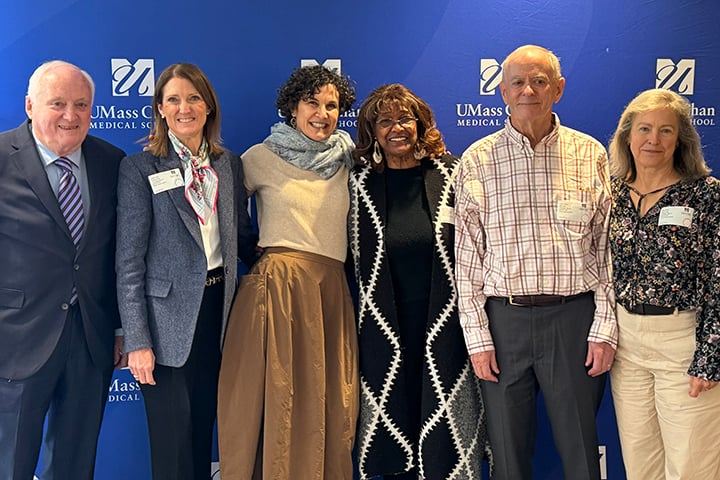
Jessica Zitter, MD, MPH, and Chaplain Betty Clark, MDiv, center, pose with Howe family members, from left, John Howe, MD, Lindsey Howe Parham, Jeff Howe and Susan Howe.
The annual Phyllis M. Howe Lecture brought the UMass Chan Medical School community together in May to reflect on one of medicine’s most enduring questions: how to care for the whole person when clinical decisions grow most complex.
This year’s program—featuring a screening and discussion of The Chaplain & The Doctor with filmmaker Jessica Zitter, MD, MPH, and Chaplain Betty Clark, MDiv—created a powerful, shared moment of learning that directly reflects the vision of the Howe family and all who have supported this endowed lectureship.
Thanks to donor generosity—and with the added strength of a recent gift from Phyllis’ son, a distinguished cardiologist, academic leader and international health expert—the lecture continues to serve as a vital forum for thoughtful dialogue on ethical decision-making in medicine.
The 2026 program invited attendees to consider how collaboration between physicians and chaplains can deepen care for patients and families facing serious illness. The film explored implicit bias in health care and how it manifests at the bedside, while also illustrating how palliative care and spiritual care work together to support patients and families.
Palliative care specialist Jennifer Reidy, MD, professor of family medicine & community health at UMass Chan, led the discussion following the screening, guiding reflection on these themes and their relevance in clinical practice.
Through the film and discussion, attendees explored how emotional and spiritual needs are inseparable from physical health—an insight at the heart of the lectureship’s founding purpose.
Organized by the Department of Medicine, members of the campus community, alongside invited guests and members of the Howe family, gathered in person and virtually to engage with the speakers. Together, they reflected on how care teams can better support patients during moments when choices about treatment, quality of life and dignity become especially complex. For learners and clinicians alike, the program offered practical perspective and renewed clarity on approaching these decisions with compassion and respect.
The lecture traces back to Phyllis MacDonald Howe, whose care journey at UMass Memorial Medical Center in the 1980s inspired her family and community to create a lasting educational resource.
The endowed lecture was established so that difficult questions—about when and how to pursue treatment, when to pause and how decisions are made—could be explored openly, guided by both clinical expertise and human understanding.
Today, that legacy continues to evolve with the changing landscape of medicine while remaining grounded in its original intent. The fund that began with memorial gifts has grown into a sustained resource supporting nationally recognized speakers and meaningful engagement each year.
“As I listened to this year’s discussion led by Dr. Zitter and Chaplain Clark, I was struck by how closely it reflects the questions that inspired this lectureship,” said John P. Howe III, MD, president emeritus of the University of Texas Health Science Center at San Antonio and former president and CEO of Project HOPE. “Our family is deeply grateful to the donors who initially supported the lecture and the Department of Medicine’s Howe Lecture committee, who have organized and engaged the Medical School community. Their efforts ensure that clinicians, trainees and the broader community have a place to explore the ethical and human dimensions of care with the depth and thoughtfulness these moments require.”