

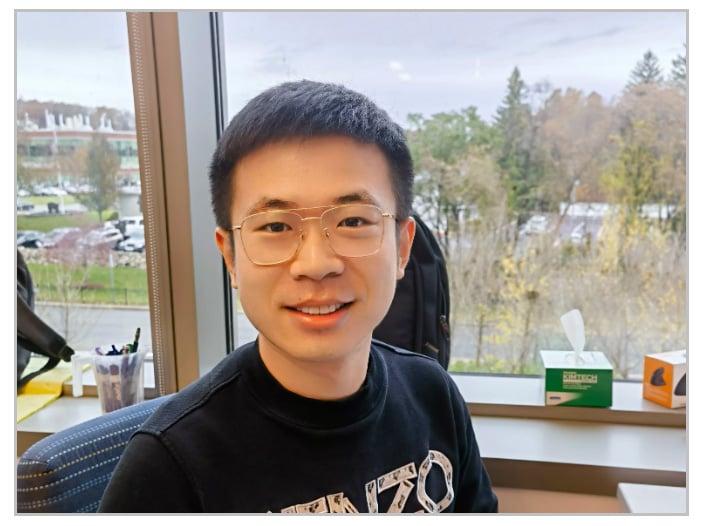
Q&A with Yuzhi Chen
Yuzhi Chen is a postdoctoral fellow in Marian Walhout’s lab.
Tell us a little bit about yourself. Where are you from? Tell us about your journey to your current position.
I was born in Xi’an, the former capital of China, a city with more than 3,000 years of history. My academic journey has taken me across three countries and has shaped both my scientific interests and my career.
I began my undergraduate studies in China before transferring to the University of Nebraska–Lincoln to complete my bachelor’s degree. There, I joined Dr. Brian Waters’ laboratory, where I worked on Arabidopsis. That experience introduced me to research and sparked my interest in experimental biology.
After graduation, I moved to the Netherlands to pursue a master’s degree at Wageningen University. It was there, in the Department of Nematology, that I was first introduced to Caenorhabditis elegans. I completed my master’s thesis under the supervision of Dr. José Lozano-Torres and Dr. Mark Sterken. I quickly became fascinated by this tiny roundworm and the remarkable insights it can provide into fundamental biological processes.
That fascination inspired me to continue my scientific journey in the United Kingdom, where I earned my Ph.D. at King’s College London in Dr. Stephen Stürzenbaum’s laboratory. My doctoral research focused on understanding the molecular responses of C. elegans to environmental carcinogens, combining molecular biology, genetics, and toxicology to investigate how organisms respond to environmental stress.
Looking back, every step—from China, to the United States, to the Netherlands, and then the UK—has broadened my scientific perspective and strengthened my passion for using C. elegans to answer important biological questions.
What motivated you to become a scientist?
I grew up living next to a university, and as a child I had the opportunity to visit some of its laboratories. I still remember being shown an instrument that could measure sound waves. I was amazed that there were invisible forces and phenomena shaping the world around us that we couldn’t see with our own eyes. That experience sparked my curiosity about science.
My first real experience as a researcher came during my undergraduate studies at the University of Nebraska–Lincoln, where I worked in Dr. Brian Waters’ laboratory. Every day, I cared for Arabidopsis plants and observed how they responded to alkaline stress. Watching those subtle changes in phenotype made me realize how much information living organisms can reveal if we ask the right questions.
What motivates me most is curiosity. Whenever I observe an unexpected result, my first instinct is to ask, “Why does this happen? What advantage does it provide to the organism? What mechanism is responsible?” Those questions have continued to drive me throughout my scientific career. The excitement of discovering something new and uncovering the mechanisms behind biological processes is what inspired me to become a scientist and continues to motivate me every day.
Why did you start working on your postdoctoral project? What first drew you to the question and Marian’s Lab?
My postdoctoral research focuses on understanding how organisms respond to metabolic dysregulation. Throughout my scientific training, I’ve been interested in how organisms adapt to different types of stress, whether it’s changes in pH, exposure to environmental chemicals, or other external challenges. I’m fascinated by the mechanisms that allow cells and organisms to sense these changes and maintain homeostasis.
I first became interested in Marian’s research nearly ten years ago. I had been following her work on gene regulatory and metabolic networks because I found her systems-level approach to biology both innovative and inspiring. When the opportunity arose to join her lab, it felt like a perfect fit.
Studying how organisms respond to metabolic perturbations allows me to build on my previous experience in environmental stress responses while expanding into a new area of metabolism and gene regulation. It is an exciting opportunity to combine my background with new approaches and to investigate fundamental questions about how metabolic changes reshape cellular responses. That combination is what drew me to Marian’s lab and continues to motivate my research today.
Can you remember the first experiment you did in Marian’s lab?
I think it was generating the mutant worm by microinjection, I had never done that before and it turns that I am actually pretty good at holding the needle steady and injecting the CRISPR mix to the correct place.
Why did you decide to apply for the American Heart Association fellowship? What does receiving it mean for you and/or your career?
I decided to apply for this fellowship because I believe that a successful postdoctoral training experience involves more than conducting and completing research projects. An equally important step is learning how to develop original research ideas, communicate their significance, and secure funding to bring them to life. Those are essential skills for becoming an independent researcher.
Do you have any advice for other young scientists at any career stage from undergraduate through postdoc?
One piece of advice I would give to scientists at any career stage is to stay focused on the scientific question you’re trying to answer. There are often many different approaches you could do, but not every experiment will bring you closer to the answer.
Research can sometimes feel overwhelming because there are so many possibilities. Staying focused on the key scientific question not only makes your work more efficient but also helps you tell a clearer scientific story. Curiosity is important but pairing that curiosity with a clear sense of purpose is what drives meaningful discoveries.
And finally, what are your future goals, where do you see yourself in 5-10 years?
I would like to establish my own research group in the next 5- 10 years.