

Photo: Shutterstock
Researchers at UMass Chan Medical School are collaborating with teams from Worcester Polytechnic Institute and Boston Medical Center on a multisite chronic low back pain study exploring how AI methods can be utilized to predict and monitor who would respond to mindfulness-based stress reduction (MBSR) to improve movement, sleep and daily functioning, without relying solely on medication.
The study, Integrative Mindfulness-Based Predictive Approach for Chronic Low Back Pain Treatment or IMPACT, includes a 350-person clinical trial and builds on mindfulness-based stress reduction, an evidence-based intervention developed more than 50 years ago at UMass Chan by Jon Kabat-Zinn, PhD, professor emeritus of medicine. The eight-week program teaches meditation, mindful movement and awareness practices designed to help individuals respond differently to pain and stress.
“This work feels like coming home,” said Paula Gardiner, MD, associate professor of family medicine & community health and a member of the research team. “MBSR was developed here, and now we’re studying it in a rigorous way to better understand how it can help people living with chronic pain.”
Chronic low back pain affects millions of adults and often impacts sleep, mood, physical activity and quality of life. While national clinical guidelines recommend mindfulness as a nonpharmacological option for both acute and chronic low back pain, it is not consistently covered by insurance.
“For low back pain, the standard of care is often medication and physical therapy,” Dr. Gardiner said. “What we’re doing is giving people an additional tool for their toolbox—something they can use day to day to manage their pain.”
Jean King, PhD, adjunct professor of psychiatry & behavioral sciences and medicine at UMass Chan and Morgan Endowed Chair of biology and biotechnology at WPI, serves as the corresponding multisite PI in the study along with David McManus, MD’02, MSc’12, the Richard M. Haidack Professor in Medicine, chair and professor of medicine; and Apurv Soni, MD, PhD’21, assistant professor of medicine.
“This is truly an amazing team. I would like to express sincere appreciation to Dr. McManus, Dr. Gardener and Dr. Soni, along with the rest of the UMass Chan team for their diligence, commitment and scientific rigor. I am convinced that this research will be transformative for many pain sufferers globally,” Dr. King said.
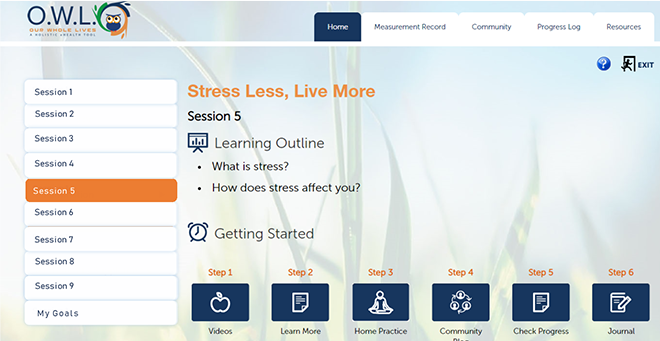
The IMPACT study enrolls participants in weekly Zoom-based mindfulness sessions led by a certified instructor. Over eight weeks, participants learn meditation practices, mindful movement and skills focused on paying attention to present-moment experience without judgment.
“Chronic pain is incredibly complex,” Gardiner said. “It affects sleep, stress, mood and how people interact with their families. Mindfulness helps people notice what’s happening in their bodies and minds so they can make choices that support their well-being.”
Participants also receive a Fitbit to track physical activity and sleep throughout the six-month study. Researchers are examining whether mindfulness influences how much participants move, how well they sleep and how comfortable they feel being physically active.
“When people have chronic low back pain, they’re often afraid that movement will make their pain worse,” Gardiner said. “That fear of movement—what we call catastrophizing—can limit recovery. We’re studying whether mindfulness can help reduce that fear and support healthier activity.”
The study is focused on predictive machine learning, which will allow researchers to analyze wearable data alongside survey responses. The goal is to not only understand whether mindfulness helps, but also to determine who is most likely to benefit.
After a successful pilot phase of 50 participants, the study is now recruiting an additional 300 adults across Massachusetts.
Gardiner emphasized that mindfulness is not about ignoring pain but about changing one’s relationship to it.
“For people living with chronic pain, it can feel isolating and invisible,” she said. “This program helps people recognize they’re not alone—and that they have skills they can develop to live their lives as fully as possible.”