

Photos: Rob Carlin (Sontheimer) and Bryan Goodchild
Investigators at UMass Chan Medical School received a $6.6 million grant from the National Institute of Neurological Disorders and Stroke to evaluate potential gene editing technologies to correct granulin mutations, one of the major genetic causes of frontotemporal dementia (FTD), with the hope that one will potentially advance to a clinical trial.
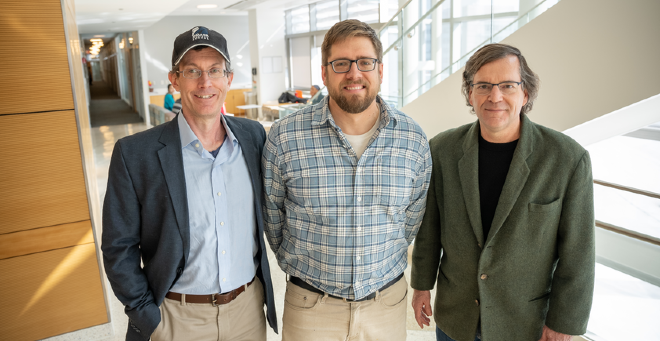
The four-year project seeks to determine the effectiveness of using a prime editing technology versus a base editing technology to correct a prevalent granulin mutation that causes FTD. The study will also assess the proficiency of delivering a gene editing therapy via an adeno-associated virus (AAV) compared to lipid nanoparticles. The study is led by Fen-Biao Gao, PhD, the Governor Paul Cellucci Chair in Neuroscience Research and professor of RNA therapeutics; Erik J. Sontheimer, PhD, the Pillar Chair in Biomedical Research and professor of RNA therapeutics; Jonathan K. Watts, PhD, professor of RNA therapeutics; and Scot Wolfe, PhD, professor of molecular, cell & cancer biology.
“This is a highly ambitious project,” explained Dr. Gao. “Unlike AAV-based gene replacement, which adds more copies of the normal gene to cells, we are trying to change a patient’s disease-causing mutation back to normal. It is very challenging to do genome editing therapies for the central nervous system. This would be one of the first tries and we have a lot to figure out before moving to the clinic.”
FTD is an age-related neurodegenerative disease that primarily affects the frontal and temporal lobes. FTD causes gradual cognitive impairment and leads to significant changes in behavior, personality and language abilities. The progression of FTD varies significantly among individuals, with life expectancy typically ranging from seven to 13 years after diagnosis. While some drugs can help patients manage their symptoms, the Food and Drug Administration has not approved a treatment for FTD.
The most common form of presenile dementia in people under 60, FTD has a strong genetic component with 40 percent of cases being classified as familial or inherited. Studies have shown that a mutation in the granulin (GRN) gene, which codes for the protein progranulin (PGRN) that is secreted outside of the cells, is one of the major genetic causes of FTD. Because of this mutation, patients do not have enough progranulin protein in the brain. Therefore, restoring progranulin production presents a promising avenue for therapeutic treatment.
The current study will evaluate the use of prime editing compared to base editing technologies to restore progranulin production in animal models and human neurons with the granulin mutation. Base editing is a gene editing technique capable of changing a single nucleotide in a sequence—adenine to guanine or cytosine to thymine, for instance. Though a mature technology, base editing is prone to bystander mutation or unintended nucleotide changes in the targeted area that could be harmful. Prime editing, meanwhile, targets a specific DNA sequence for replacement and can edit longer sequences, which means there are few unintended insertions or deletions to the sequence. However, because the prime editing mechanism requires a longer RNA guide, it is larger and more difficult to deliver to cells. Both techniques are forms of CRISPR and use the Cas9 protein to make single strand breaks in the target DNA.
“On one level, base editing is a bit more realistic,” explained Dr. Sontheimer. “It’s a more mature technology and is easier to deliver to cells. Prime editing, however, has an advantage because the bystander problem at this site is going to be severe. If we can’t solve the bystander problem, then prime editing may prove to be more efficient.”
The researchers won’t have to correct every cell to restore progranulin protein function.
“It’s not that there isn’t any progranulin protein being produced,” explained Sontheimer. “There’s still one normal gene making the protein. It’s just there isn’t enough progranulin in the cells. How much production we have to restore in order to see improvement, we don’t know what that is yet.”