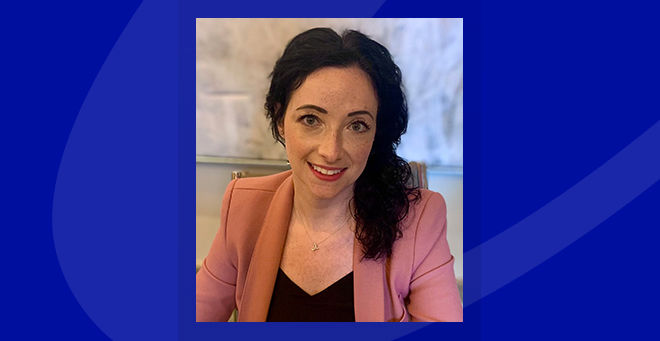


Photo courtesy of Ekaterina Pivovarova
An intervention aimed at improving collaboration between drug courts and community treatment providers is being conducted in two states to support individuals in receiving treatment and staying out of jail.
The randomized controlled trial, led by Ekaterina Pivovarova, PhD, associate professor of family medicine & community health and emergency medicine, at UMass Chan Medical School, will implement Clinical Organization and Legal Agency Alliance Building (COLAAB) in 16 adult drug courts in Massachusetts and Florida.
The five-year study is funded by a $3.5 million award from the National Institutes of Health.
Despite drug courts requiring that individuals receive treatment, they cannot provide treatment, and as such must rely on outside providers.
“There is often a disconnect between drug courts and treatment providers and this approach that we’re using will hopefully bring these two organizations together in a structured way,” Dr. Pivovarova said. “It’s an exciting thing to be doing and we now get to see whether this approach might make it easier for participants to access treatment and if it will help to improve the connections between the courts and the treatment providers.”
“Ultimately, all of this leads to getting people the treatment that they need and keeping them out in the community, as opposed to incarceration or potentially experiencing an overdose,” she added.
The COLAAB intervention will include monthly meetings between the courts and Medication for Opioid Use Disorder (MOUD) providers that will be facilitated by academic liaisons. Topics will include barriers to referrals to providers and misconceptions about treatment and legal processes and communication processes. Court staff will visit provider agencies and providers will observe court hearings; and documents will be created for each court that will include MOUD provider information.
Pivovarova said they anticipate enrolling 100 court and treatment provider staff members, as well as around 60 individuals receiving treatment.
Pivovarova will lead UMass Chan’s efforts in the study, joined by Bruce A. Barton, PhD, professor of population & quantitative health sciences; Dara Drawbridge, PhD, assistant professor of psychiatry & behavioral sciences; Peter Friedmann, MD, MPH, professor of population & quantitative health sciences; and Elizabeth Evans, PhD, professor of public health at UMass Amherst. Efforts in Florida will be directed by Barbara Andraka-Christou, JD, PhD, associate professor at the School of Global Health Management and Informatics at the University of Central Florida.
Alexandra Boland, MHC, a clinical research program manager in the Department of Family Medicine & Community Health at UMass Chan, and Suhas Shewale, PhD, MPH, a postdoctoral researcher at UCF, round out the research staff.
The research team has partnered with the Massachusetts Executive Office of the Trial Court and the Florida Office of the Problem-Solving Courts. Treatment provider agencies include Spectrum Health Systems, Community Health Link and STAR in Massachusetts; and Aspire Health Partners, Lutheran Services and Behavioral Health Systems in Florida.