Photo: Hallie Leo
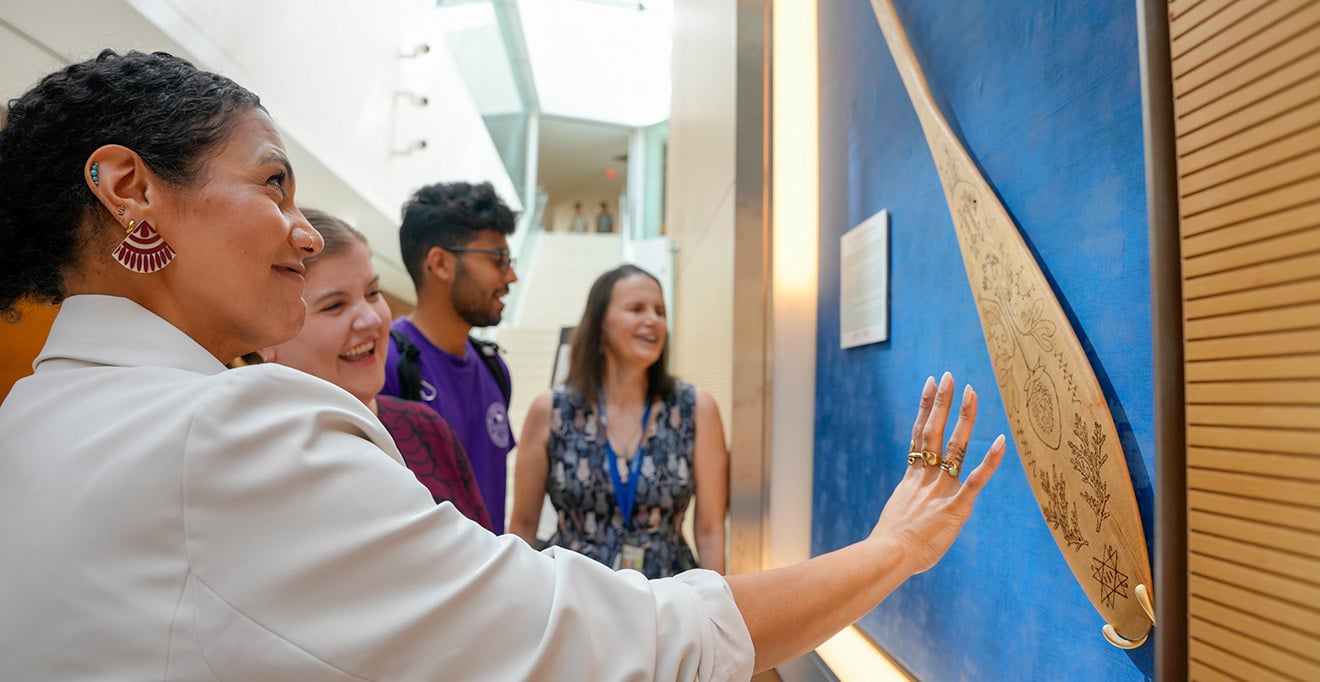
New Indigenous art is on display at UMass Chan Medical School, unveiled during a reception in the Albert Sherman Center on Tuesday, Sept. 16. A long sassafras paddle with meaningful pyrographic designs crafted by Nipmuc artists and commissioned by the Diversity and Inclusion Office and the Lamar Soutter Library is mounted in the Sherman Center on the wall at the second floor stair landing.
“This artwork was commissioned and created to embody and extend UMass Chan’s land acknowledgement, not only as words we say, but as something we see and experience together,” said Jeanna Lee, PhD, assistant director for equity, inclusion and campus climate and assistant professor of family medicine & community health and psychiatry & behavioral sciences. “I hope this artwork serves as a marker of our commitment to remembering, honoring and learning from histories that shape where we are today.”
UMass Chan’s land acknowledgment affirms the Medical School’s intention to work with Indigenous neighbors to create new legacies of equity and respect.
Funded by the Lamar Soutter Library, “Kooweechaush (I go with you)” was harvested and carved by Nipmuc sculptor Andre Strongebearheart Gaines Jr. and burned and etched by Nipmuc maker Kimberly Toney, MPP, the coordinating curator for Native American and Indigenous Collections at Brown University. In reference to Nipmuc or freshwater people, the paddle represents their connection to all bodies of water in Nipmuc homelands. Toney’s designs burned into the wood contain symbols from Nipmuc traditional medicines including cedar, red willow, strawberries, beaver paw prints, cattails, corn and patterns found on Nipmuc-made baskets.

Photo: Hallie Leo
“Cedar, a sacred medicine, and red willow are used medicinally and in ceremony,” said Toney. “These medicines center healing and promote kinship. Cattails are a traditional food, but also a material woven together into mats that have, for thousands of years, been used by us to welcome people into our homes or provide them comfort. Community care and rest are medicine. Food is medicine.”
Mary Piorun, PhD, MBA, MSLS, director of library services and associate professor of nursing, hopes to bring more Indigenous art to campus.
“We want to continue to fill the other windows along the staircase, but I’d also like to see representation in every building and even outside,” said Dr. Piorun. “I’d love to see some all-weather sculptures available to help remind people of where we are and the people who’ve been here before us.”
Toney added that art reminds us of the value of relationships with the Indigenous community.
“Science offers one kind of care. Our indigenous teachings offer another. Both have value together,” Toney said.