
Photo: Bryan Goodchild
The Gates Foundation is providing funding to two labs in the Program in Microbiome Dynamics at UMass Chan Medical School for research aimed at improving pregnancy outcomes and gut health in women from low- and middle-income countries.
The lab of Vanni Bucci, PhD, professor of microbiology, received a $2 million award from the Gates Foundation, a private philanthropic organization founded by Bill and Melinda Gates, to support its participation in the Experimental Medicine Platform (EMP), a research initiative aimed at improving pregnancy outcomes for women affected by a gut condition known as environmental enteric dysfunction, or EED. This condition is linked to poor nutrition, infection and chronic gut inflammation, which can lead to poor pregnancy outcomes, including preterm birth.
“We are focused on maternal health, and our overall goal is to intervene during pregnancy, to get a better start for the baby,” Dr. Bucci said.
Clinical trials aiming at reducing EED burden with beneficial bacterial cocktails, known as live biotherapeutic products (LBPs), are ongoing in Pakistan, Bangladesh, Zambia, Burkina Faso and Senegal. As of July, the trial has enrolled nearly 600 women. These LBPs can restore microbial balance in the gut and reduce inflammation caused by harmful bacteria.
Since 2022, the Bucci lab has been supporting the EMP project in three main areas: using advanced computer methods and machine learning to analyze data from thousands of women participating in EMP studies; analyzing complex datasets to study how treatments that change the gut microbiome (like beneficial bacteria) affect pregnancy outcomes; and building computer models that simulate how gut bacteria interact with each other and with the body.
“For the EMP, the Gates Foundation was looking for expertise in data analysis, bioinformatics and computational biology. The role of my lab in these human trials is to do two things: to parse out signals from noise and find clinically relevant signals and biologically relevant signals that can inform the next trial. The other thing is to do mechanistic validation, find some links between the data, and go into the lab and prove that it’s correlation versus causation in simplified systems,” Bucci said.
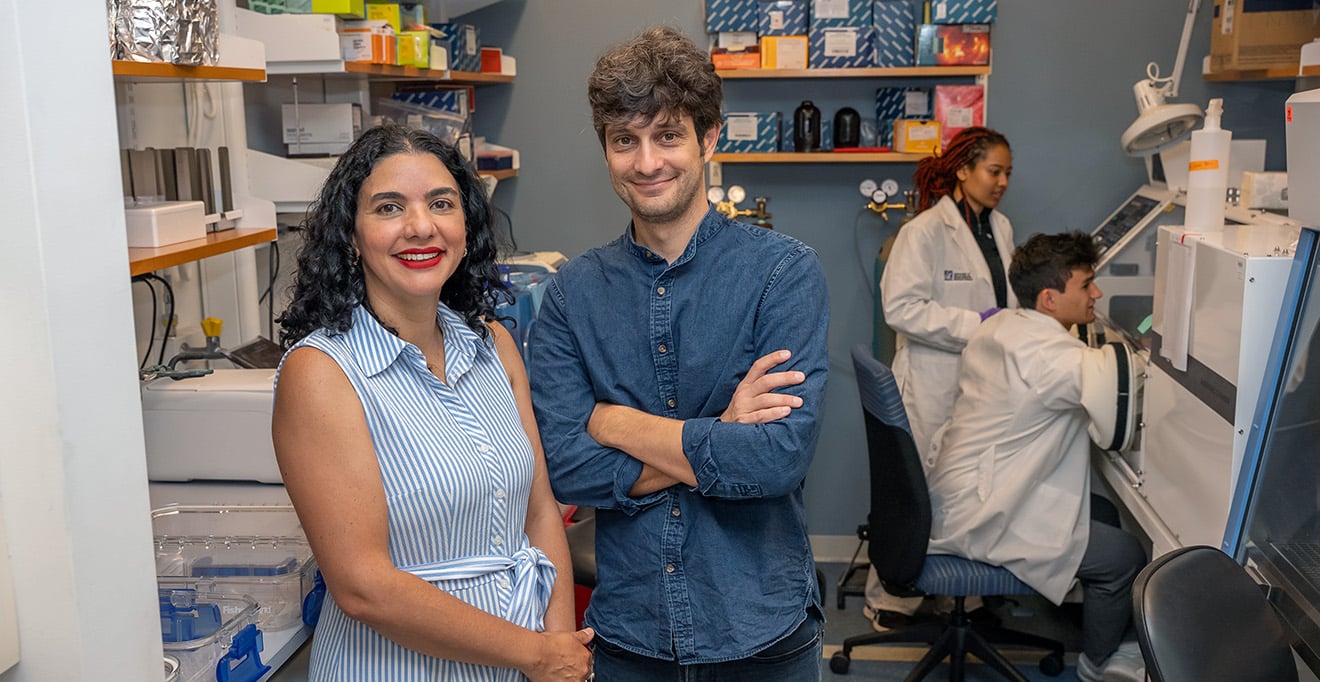
In collaboration with the Bucci lab, the lab of Ana Maldonado-Contreras, PhD, the Marcellette G. Williams Scholar, assistant professor of microbiology, and co-founder of the Center for Microbiome Research, was awarded $945,000 from the Gates Foundation to validate strategies that can be used in the field to support colonization of LBPs throughout pregnancy.
“There are several LBP candidates that can overcome EED. Now, the challenge is to make the bacteria on those LBPs stay in the gut during pregnancy. Our study is testing whether using targeted dietary supplementation, such as particular fibers, instead of antibiotics, can help beneficial bacteria in LBPs take hold and thrive in the gut,” Dr. Maldonado-Contreras said.
These targeted dietary supplements can be digested only by the bacteria in the LBPs.
Maldonado-Contreras and Bucci believe this research will lead to the discovery of a new, antibiotic-free way to improve gut health and pregnancy outcomes in vulnerable populations, simply by feeding the beneficial bacteria in the LBPs.
Bucci and Maldonado-Contreras were in attendance at the Gates Foundation in Cambridge on Monday, Aug. 4 for the Foundation’s major announcement of a $2.5 billion commitment through 2030 to accelerate research and development focused exclusively on women’s health.