

At a glance |
|---|
|
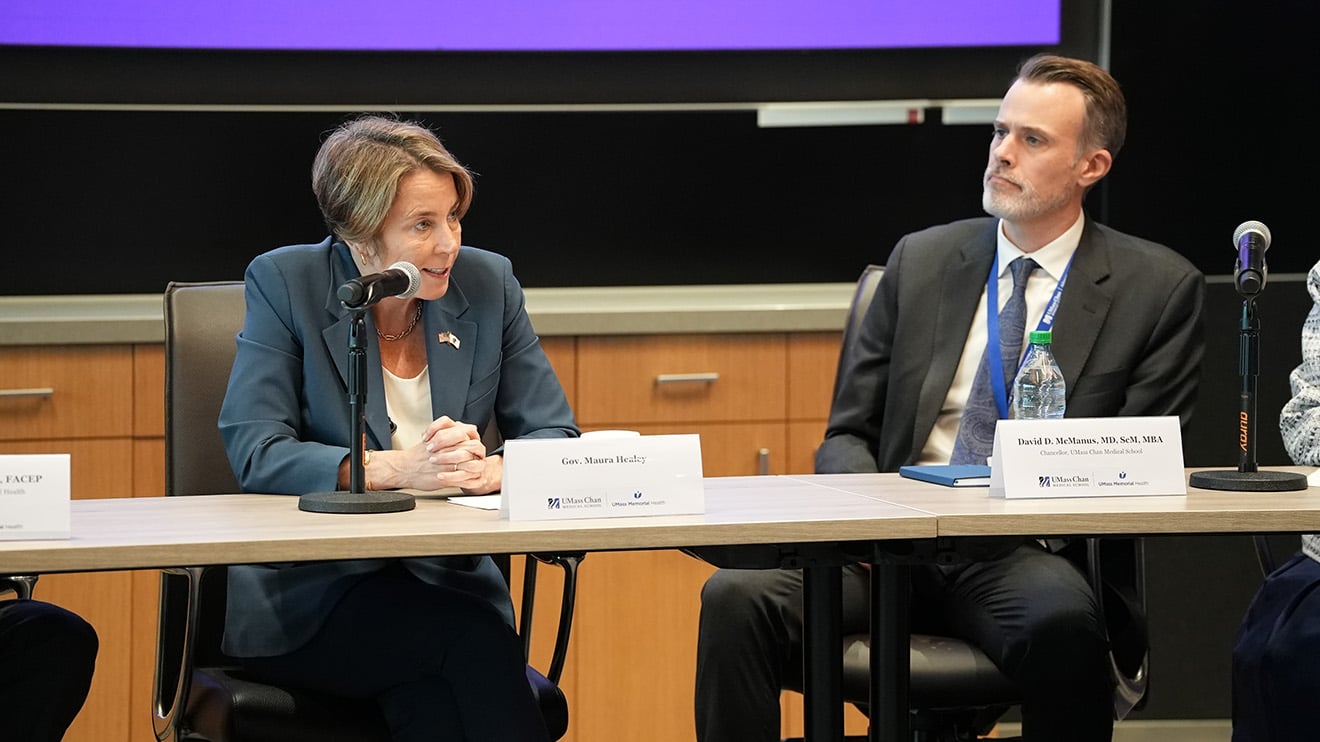
Photo: Bryan Goodchild
Programs connecting advanced care for maternal health and redesigning postpartum care in Massachusetts were the focus of a roundtable discussion led by Gov. Maura Healey at UMass Chan Medical School on Wednesday, Oct. 21.
Joined by Chancellor David D. McManus, MD’02, ScM’12, MBA, and Eric Dickson, MD‘95, president and chief executive officer of UMass Memorial Health, Healey laid out the commonwealth’s priorities for addressing maternal mental health, including sharing details of the Healey-Driscoll administration's recent $2 million proposal to expand postpartum home visiting services and strengthening maternal mental health supports.
“Massachusetts is a great place for moms and families and it’s the best place to be a mom and raise kids. We know we have our challenges, but we are doing everything we can to support our moms and support those who are supporting our moms,” Healey said. “I’m really proud that our state medical school is leading here in Massachusetts and across the country in helping others implement these programs.”
The roundtable discussion, co-hosted by UMass Chan and UMass Memorial Health, was facilitated by Tiffany A. Moore Simas, MD’00, MPH, MEd, MHCM, the Donna M. and Robert J. Manning Chair in Obstetrics & Gynecology, chair and professor of obstetrics & gynecology, and professor of pediatrics, psychiatry & behavioral sciences, and population & quantitative health sciences.
“The connection between our community partners and hospital and medical school is absolutely critical to having a safety net to cradle our moms. We need to take care of the moms that are taking care of the babies. That is the foundation on which our societies are created and will continue to thrive and move on,” Dr. Moore Simas said.
The discussion highlighted programs dedicated to enhancing maternal health outcomes, addressing social determinants of health and providing comprehensive support.
These included initiatives developed at UMass Chan such as the EMPOWER program, which is designed to improve outcomes for new mothers who are Black, Hispanic or marginalized by socioeconomic disadvantage; and the Massachusetts Child Psychiatry Access Program (MCPAP) for Moms, a statewide program funded by the Department of Mental Health to build the capacity of perinatal care professionals to address mental health and substance use disorders among perinatal individuals.
Other programs featured in the discussion included the UMass Memorial Doula Program which connects patients with community doulas from diverse backgrounds; and Worcester RISE (Refugee and Immigrant Support and Empowerment) for Health, an organization providing comprehensive and culturally responsive healthcare and support services to refugees and immigrants in Worcester.
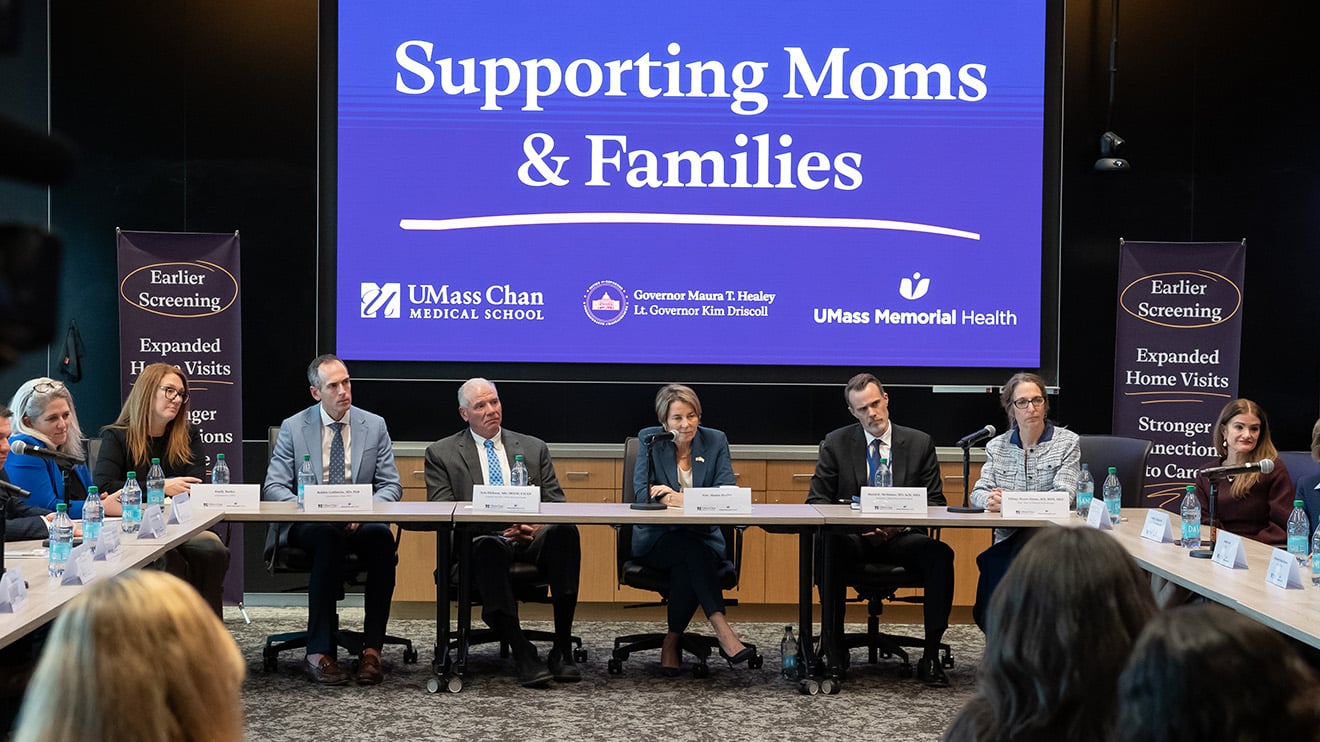
Photo: Bryan Goodchild
From UMass Chan, Moore Simas was joined by Nancy Byatt, DO, MS’15, MBA, professor of psychiatry, obstetrics & gynecology, and population & quantitative health sciences, and founding medical director of MCPAP for Moms; Olga Valdman, MD’09, assistant professor of family medicine & community health, and founder and executive director of Worcester RISE; and Kimberly A. Yonkers, MD, the Katz Family Chair in Psychiatry & Behavioral Sciences, and chair and professor of psychiatry & behavioral sciences.
Dr. Yonkers is the lead investigator at UMass Chan on a clinical trial to evaluate SAINT neuromodulation therapy, a noninvasive, drug-free therapy for patients with treatment resistant postpartum depression.
“We’ve heard a lot about maternal mental health in the news recently, including that there aren’t adequate treatments, particularly for postpartum psychosis as well as other postpartum disorders. We are the only site in Massachusetts and one of three in the country that is evaluating transcranial magnetic stimulation in a very high-capacity way. It’s a one-week, rapid treatment that helps moms with postpartum depression,” Yonkers said. “We're very proud to be the first in the commonwealth to be able to do this and we hope this can be an arrow in our treatment armamentarium that we can offer our patients.”
The discussion also included perspectives from patients directly impacted by MCPAP and the UMass Memorial Doula Program. Jennifer Ford, a patient with lived experience with postpartum depression following the birth of her second child, said she was fortunate to have support from her husband and to receive special care from UMass Memorial and support from MCPAP for Moms but stressed that stories like hers highlight the need to improve screening for perinatal mood and anxiety disorders and connect families with care earlier.
“When I got pregnant with my second daughter, I felt like I wasn't in my own environment. I didn't know where I was, and I just had this intense feeling of despair and grief and loss. My doctor connected me with MCPAP for Moms and within weeks I was connected with a social worker, therapist, group therapy and a psychiatrist. That saved my life. I’m here because of MCPAP for Moms," Ford said.
Esther Odame, a new mother who provided a patient perspective for the benefits of having support from a doula, was joined by Shantel Collins, a trained birth doula and owner of Downtown Dula of Worcester; and Oluwakemi Olusola Okufuwa, a doula who supported Odame during her pregnancy.
UMass Memorial was also represented on the roundtable by Cynthia Barginere, UMass Memorial Health COO and Justin Precourt, president of the UMass Memorial Medical Center. Also in attendance were Amy Rosenthal, Executive Office of Health and Human Services undersecretary of health; Robbie Goldstein, MD, PhD, commissioner of the Massachusetts Department of Public Health; Emily Bailey, commissioner of the Massachusetts Department of Mental Health; and Seema Dixit, Worcester commissioner for Health and Human Services.


