
At a glance |
|---|
|
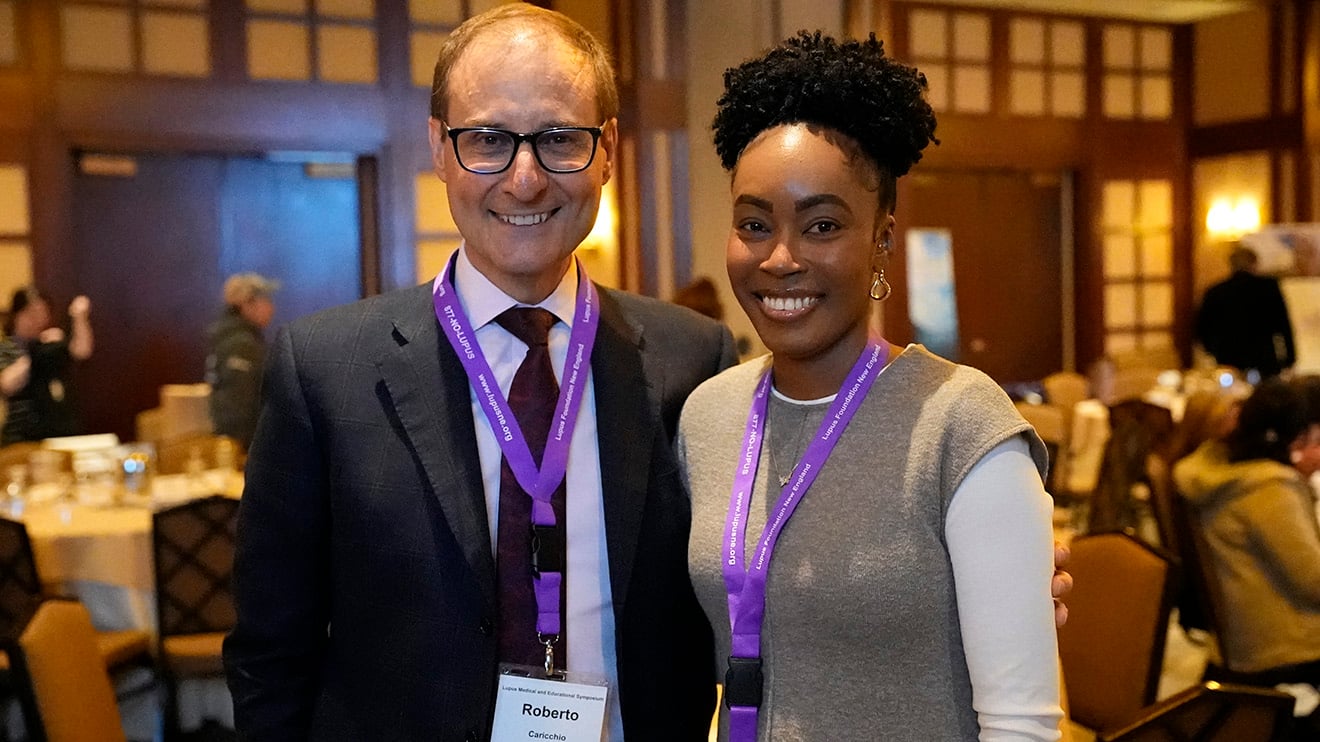
Photo: Pat Sargent
It’s been more than two years since Talaya Reid started chimeric antigen receptor (CAR) T cell therapy at UMass Chan Medical School to treat severe symptoms caused by the chronic autoimmune disease known as lupus nephritis.
Since then, the results have been promising, and Reid said her quality of life has improved dramatically.
“Over the past two years, the improvements in my life have become a new normal. I haven’t had any flares. I’m not on any lupus medications. I haven’t had any pain in my joints or felt any fatigue or have had any new rashes. It’s been a great experience and I’m so happy that I went through with the clinical trial,” Reid said.
Reid, 30, a pharmaceutical scientist from Fairless Hills, Pennsylvania, was diagnosed with lupus at 22. In 2024, she was the first of three people living with lupus to enroll in an individualized clinical research study exploring the use of CAR T cell treatment in lupus nephritis for severe or nonresponsive lupus at the Lupus Center at UMass Chan.
Reid said the cell therapy treatment has allowed her to enjoy spending time outdoors during the summer months. She said before the treatment it was hard for her to be out and about with friends and family because she was always worried about being in the sun too long.
“I still use sunscreen, but now if I’m outside for a long time, my skin doesn’t react anymore,” said Reid. “I’m no longer in constant fear that I’m going to trigger another flare because I’m spending time outside with friends or at the beach.”
Lupus is a chronic autoimmune disease that involves multiple organ systems and often requires lifelong treatment with immunosuppressive or immunomodulatory drugs, which are not effective for all patients.
CAR T cell therapy works by removing some of a patient’s white blood cells, including T cells, and genetically altering them in a lab. Once returned to the body, these changes help the patient's T cells identify and kill antigens on the outside of harmful cells.
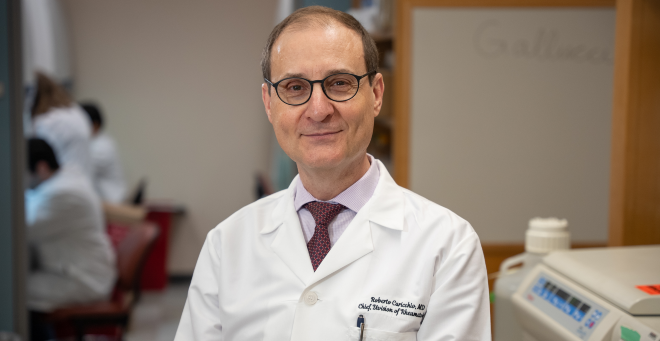
Roberto Caricchio, MD, the Myles J. McDonough Chair in Rheumatology, professor of medicine, chief of the Division of Rheumatology in the Department of Medicine and director of the Lupus Center at UMass Chan, is principal investigator of the CAR T cell therapy trial in lupus at UMass Chan. He is also Reid’s rheumatologist.
“To see this young woman, now two years out from her treatment and looking healthy, it’s powerful and something I’ll never forget. It’s really wonderful,” Dr. Caricchio said. “I couldn't be happier. We’ve treated other patients, but of course, the first patient is special.”
According to Caricchio, the two other people with lupus enrolled in the CAR T therapy trial are both doing well and the results are similar to Reid’s.
“Talaya’s goal now should be to enjoy her life and continue to take precautions. If she wants to go to the beach, she should continue to wear a hat and sunscreen. That’s what’s really required,” Caricchio said.
For Reid, she’s optimistic about her future and is looking forward to continuing to enjoy her life without worrying about lupus flares interrupting her daily routine.
“My life is a complete 180 to how it was before I received the treatment. I have so much energy. I go to the gym, hang out with friends and go places with my family. I don’t feel like I have to cancel plans at the last minute. My hair grew back, so I’m happy about that, too,” Reid said. “It’s more than I could have imagined. Before the treatment, I just had the idea that lupus was something that I would have to deal with forever, and there wasn't going to be any relief from the disease. Now, I just feel like I'm living this new normal.”
The Lupus Center is led by Caricchio and Elena Gkrouzman, MD, assistant professor of medicine, and includes a team of dedicated experts, including rheumatologists, dermatologists and nephrologists, as well as clinical research coordinators.
The CAR T cell therapy clinical trial at the Lupus Center is conducted in collaboration with the Cancer Research Office at the UMass Cancer Center; the Blood Cancer Center physicians and teams; and the Divisions of Hematology/Oncology and Renal Medicine/Nephrology in the Department of Medicine.