

Photo: Bryan Goodchild
At a glance |
|---|
|
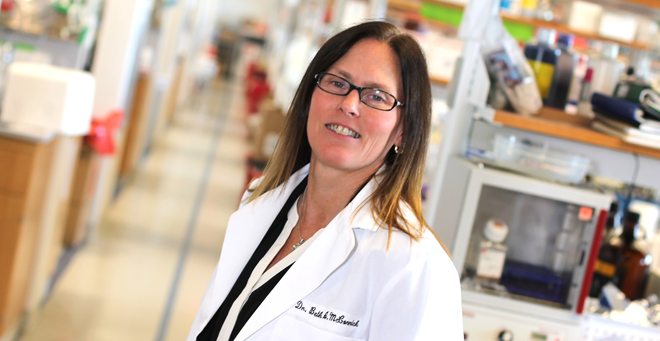
UMass Chan Medical School scientist Beth McCormick, PhD, and her team collaborated with researchers at the University of Bath to discover how neutrophils, the body’s most abundant type of white blood cells, travel to infection sites without damaging healthy tissue. These findings, published in Science Advances, represent a potential new target for anti-inflammatory drugs.
“One of the greatest challenges in treating chronic inflammatory disease is preserving the immune system’s ability to fight infection while preventing unnecessary tissue damage,” said Dr. McCormick, the Worcester Foundation for Biomedical Research Chair II and chair and professor of microbiology. “By uncovering this molecular navigation system that precisely directs neutrophils to sites of infection, we’ve identified a promising therapeutic strategy that could restore precision to inflammation rather than simply suppressing it. We believe this represents an important step toward a new generation of targeted anti-inflammatory therapies.”
What are neutrophils and why are they important?
Neutrophils play a key role in the innate immune response. The most abundant type of white blood cell in the body, these cells act as a rapid, first line of defense against microbial and viral infections.
Understanding how neutrophils travel is key to developing new therapeutic strategies. Current anti-inflammatories dampen inflammation throughout the body, leading to inadequate outcomes with side effects.
“Neutrophils are cells that can act like bombs, releasing a deadly cocktail of chemicals to kill off disease-causing microbes once they reach a site of infection,” said Randy Mrsny, PhD, professor of pharmacy & pharmacology in the Centre for Drug Discovery based in the Department of Life Sciences at the University of Bath. “Unfortunately, in patients with chronic inflammation, their neutrophils can get incorrect signals, making them act as though there is an infection to be neutralized, setting off these bomb-like events and leading to unnecessary tissue damage.”
How do neutrophils fight infection without damaging healthy tissue?
McCormick and Dr. Mrsny have identified a multi-step process in which neutrophils that come out of blood vessels near an infection are guided to specific tissue sites to confront infecting microbes or viruses.
When a cell becomes infected, it releases a short-lived molecule called hepoxilin A₃ that is detected by a sensor protein on the surface of neutrophils called TRPV2. Once the infection is detected, TRPV2 combines with type 2 cannabinoid receptor (CB2R) to form a protein assembly called a signaling complex that directs the migration of neutrophils selectively toward sites of infection by releasing hepoxilin A₃.
Surprisingly, neutrophils responding to these signals do not release any caustic agents while they are migrating to an infection. This explains how neutrophils can be guided to the precise site of an infection without damaging tissues.
Understanding the finely tuned neutrophil navigation system
Previous studies by this team showed how CB2R activation by endocannabinoids could suppress the release of hepoxilin A₃ by the signaling complex, acting as a brake when there is no infection and stopping neutrophils from attacking healthy cells.
In the current study, researchers further discovered that when the TRPV2 signaling complex binds to CB2R, it switches off this brake and directs the neutrophils toward the infection site where they can release a cocktail of chemicals to kill the microbes causing the infection.
These findings demonstrate how the TRPV2/CB2R receptor navigation system works in concert, akin to linking an accelerator with a brake, providing a finely tuned navigation system for neutrophils to reach sites of infection.
“We’re really excited that after nearly 15 years working in this area, we’ve identified exactly how neutrophils ‘know’ how to move, stop and even change direction to specifically target the infection site and unleash their anti-infection weapons at just the right moment to limit damage to healthy tissues,” said Mrsny. “By understanding this mechanism, we can in the future design treatments that target this process with more specific and effective approaches.”
What’s next for this area of research?
A new treatment tailored to block the hepoxilin A₃ signal through its actions on the TRPV2/CB2 receptor complex would provide a novel mechanism to specifically treat inflammation only when and where it happens to limit chronic events, according to McCormick and Mrsny.
The next step for investigators is exploring how the hepoxilin A₃ signal pathway could be blocked as a potential new class of anti-inflammatory drug molecules.