
Photo: Pat Sargent
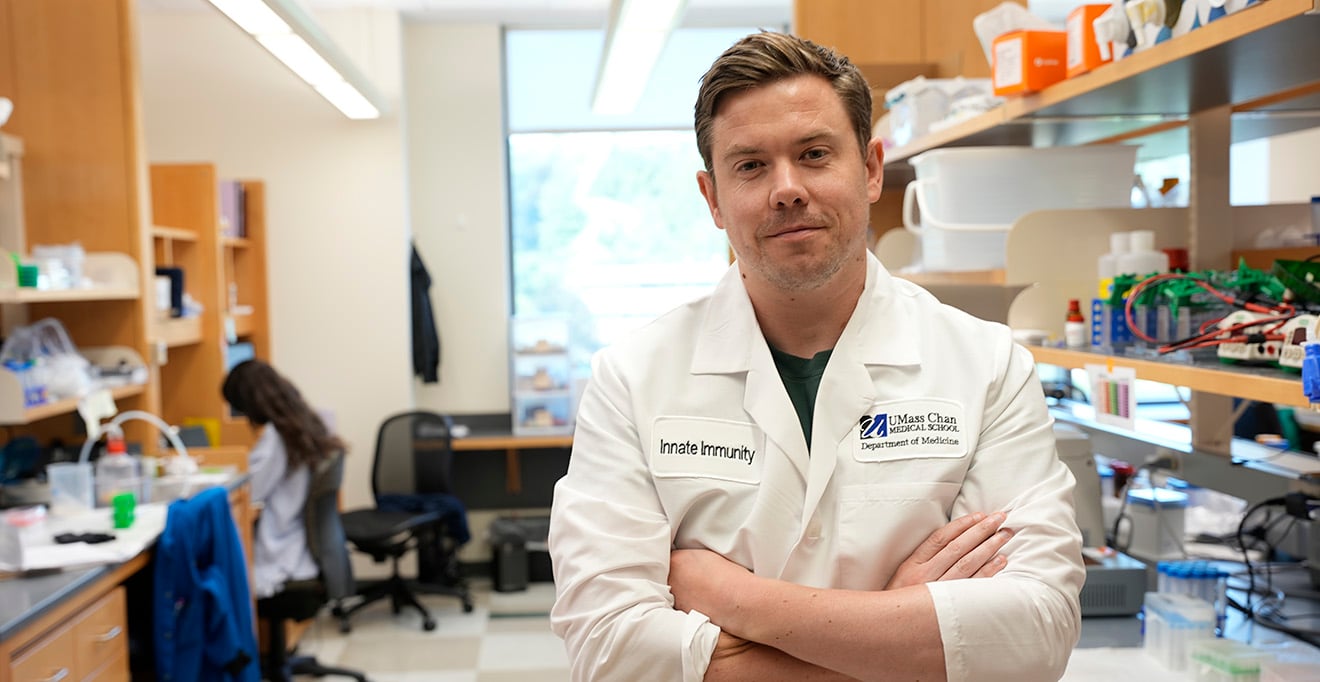
Research projects exploring potential treatments for Parkinson’s disease, lupus and sepsis are underway at UMass Chan Medical School in the lab of Fiachra Humphries, PhD, assistant professor of medicine.
Dr. Humphries is a principal investigator on three National Institutes of Health (NIH) grants issued over a six-week period starting June 11, totaling nearly $8 million.
“I've been lucky, given the uncertain funding environment that we’re in now. UMass Chan provides young faculty with amazing support and the freedom to do the research that we want to do,” Humphries said. “These grants have all come in around the same time, but there are a lot of years of work behind them.”
Humphries received a five-year, $3.8 million NIH R01 award from the National Institute of Allergy and Infectious Diseases for his research identifying how the metabolite fumarate is a critical regulator of cell death; accumulating in the body and attaching to and inactivating specific proteins, thereby reducing inflammation. His lab has found that fumarate can regulate Parkinson’s disease. By changing the levels of fumarate in the brains of animal models, scientists can also reduce inflammation, potentially paving the way for treatments for inflammatory diseases, including Parkinson’s disease.
On July 1, Humphries was notified he received a two-year, $460,000 NIH R21 exploratory research grant to support his work studying a pathway he discovered called the non-canonical TLR (toll-like receptor) signaling pathway, which controls the transcription factor NRF2 and a scavenger receptor called macrophage receptor with collagenous structure (MARCO).
“MARCO is like a cellular sponge. It just mops up inflammatory signals and eliminates them,” said Humphries. “What we found is that MARCO is very important in minimizing the effects of lupus.
“Over time, patients with lupus lose MARCO,” said Humphries. “The goal of this grant is to develop new therapies for lupus by switching on MARCO and understanding how it mops up all the inflammatory signals that drive the disease.”
Humphries was notified of a third grant, another NIH R01 award, in late July. This award, a five-year, $3.6 million grant, will fund his continued research on MARCO and additional proteins controlled by the non-canonical TLR signaling pathway. The research focuses on the ability of non-canonical TLR signaling to limit the development of sepsis, the body’s overreactive response to an infection.
“These grants really sum up the theme of the lab, switching on this anti-inflammatory pathway, looking at the different genes that are turned on, applying them to different disease models and seeing where the biology fits,” Humphries said. “Our core interest is innate immune signaling and now with these grants we can cast the net wide in terms of the diseases driven by innate immunity.”