
Photo: Bryan Goodchild
A new study from the Department of Neurobiology at UMass Chan Medical School focuses on the diversity of alcohol drinking behaviors in alcohol use disorder (AUD), with findings indicating that individuals displaying certain problematic drinking patterns may be more susceptible to relapse than others.
“Many of the ways to treat use disorders still involve an abstinence phase, and maintaining abstinence is extremely difficult, especially in individuals with alcohol use disorder,” said Danny G. Winder, PhD, the Worcester Foundation for Biomedical Research Chair I and chair and professor of neurobiology. “We think it’s important to understand what sort of things happen in the brain during abstinence that might propel problems like relapse. There are markers we can look for and things that we might be able to examine that could mitigate the likelihood that abstinence is going to end in relapse.”
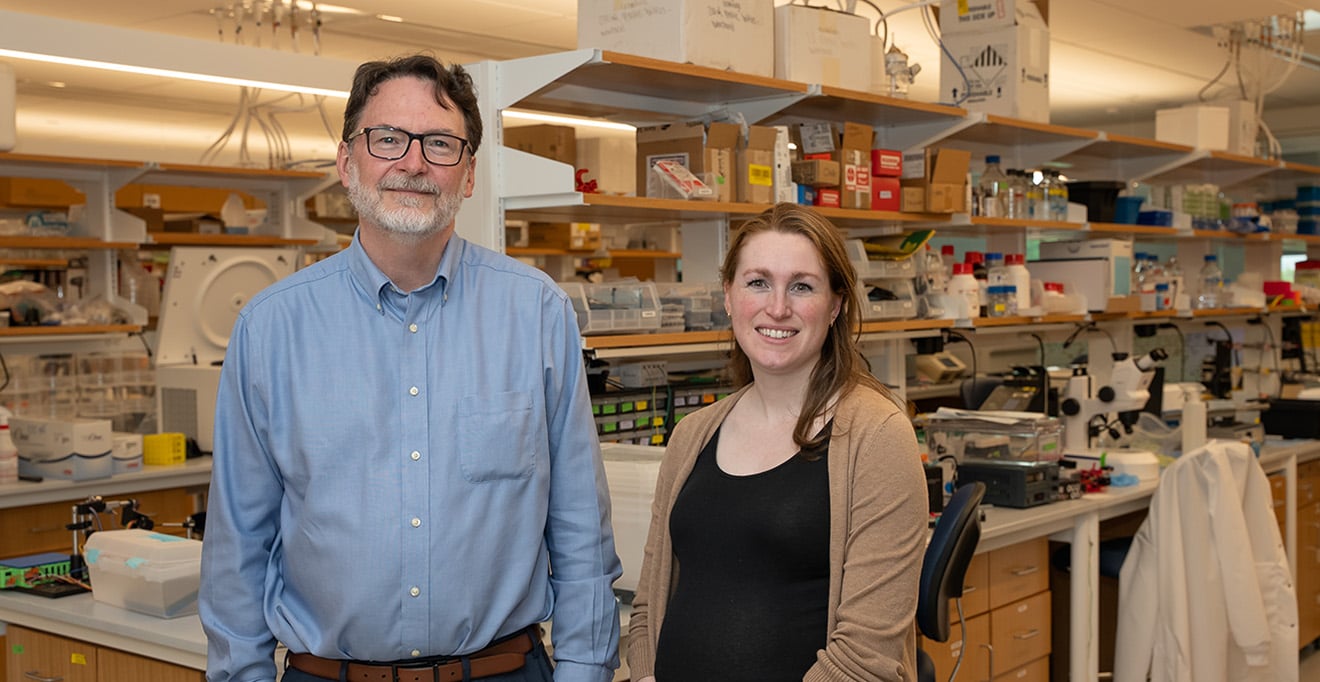
The study, published in Molecular Psychiatry and led by Dr. Winder and Marie Doyle, PhD, instructor in neurobiology, uses animal models to examine brain activity in the bed nucleus of the stria terminalis (BNST) during alcohol abstinence in association with problematic drinking and alcohol seeking behaviors.
In the AUD clinical population, periods of alcohol abstinence are often a high-risk stage of recovery, when increased anxiety and depression are thought to trigger stronger cravings for alcohol. The BNST is a small but mighty part of the brain that acts as a neural hub for signals related to alcohol reward, stress and anxiety. The research team’s findings show that BNST activity predicts aversion-resistant drinking, or the continued consumption of alcohol despite negative consequences, and identifies a subset of animals prone to persistent alcohol seeking.
“The focus of this research is on individual differences. The overall goal is to understand how individuals can vary within a population,” Dr. Doyle said. “We see this at the clinical level. About 10 percent of adults in the U.S. will have a diagnosis of alcohol use disorder, but a much larger proportion of adults consume alcohol throughout their lifetime. So why do some people develop an alcohol use disorder and some people don’t? That’s the big picture idea for the study.”
Doyle conducted several experiments to specifically examine BNST neuron activity patterns in an animal model while they are in abstinence after volitional alcohol intake. According to Winder, most studies in this field are focused on models in which alcohol intake is directly controlled by researchers. In this study, the animals had the choice to drink alcohol or refrain daily over several weeks. This distinction is important because it resulted in a wide range of alcohol consumption. Some animals drank large amounts of alcohol, while others drank very little, reflecting the variety of drinking patterns seen in humans. They were then moved into an abstinence phase.
“What Dr. Doyle was able to do was show that the BNST activity tracks with the drinking behavior and that activity signal predicted the aversion-resistant alcohol intake,” Winder said. “It was like a marker of a population of animals that are going to go on to potentially engage in maladaptive alcohol seeking. The BNST signal seemed to grow during abstinence, potentially predicting the aversion-resistant drinking. It’s interesting that this diversity of responses happens in animals that are genetically identical. This means that there are aspects of the environment and perhaps social aspects of the animal’s behavior that could set up these kinds of changes.”
Winder has a long-term collaboration with Jennifer Blackford, PhD, director of research at the Munroe-Meyer Institute and the Hattie B. Munroe Professor at the University of Nebraska Medical Center, whose lab was the first to image the human BNST using MRIs. The lab has been working on imaging the BNST in humans with AUD in early abstinence, allowing Winder and Doyle to draw parallels between their work with animal models and what the Blackford Lab is doing in the clinical population. This research is part of an NIH-funded alcohol center aimed at developing translational research programs.
Moving forward, Winder, Doyle and the research team aim to identify molecular targets related to BNST brain activity for the potential development of personalized therapeutics for people with AUD.
“By understanding the underlying biology, we can start to dive deeper and deeper into what’s causing these changes in behavior on a molecular level,” Doyle said. “This study has allowed us to look at animal models on an individual level; but now we’re asking, can we have individual therapeutics that will help subsets of people? When it comes to potential therapies, trying to tease out what might work for certain individuals, especially those that are more likely to relapse, is important.”