

Photo: Bryan Goodchild
New research out of UMass Chan Medical School reveals how a gene-silencing therapy targeting age-related macular degeneration (AMD), a leading cause of visual impairment in older adults, could potentially pause visual decline and improve the lives of people living with the disease.
Current AMD therapies require frequent eye injections—as often as once a month—that can be uncomfortable and stressful.
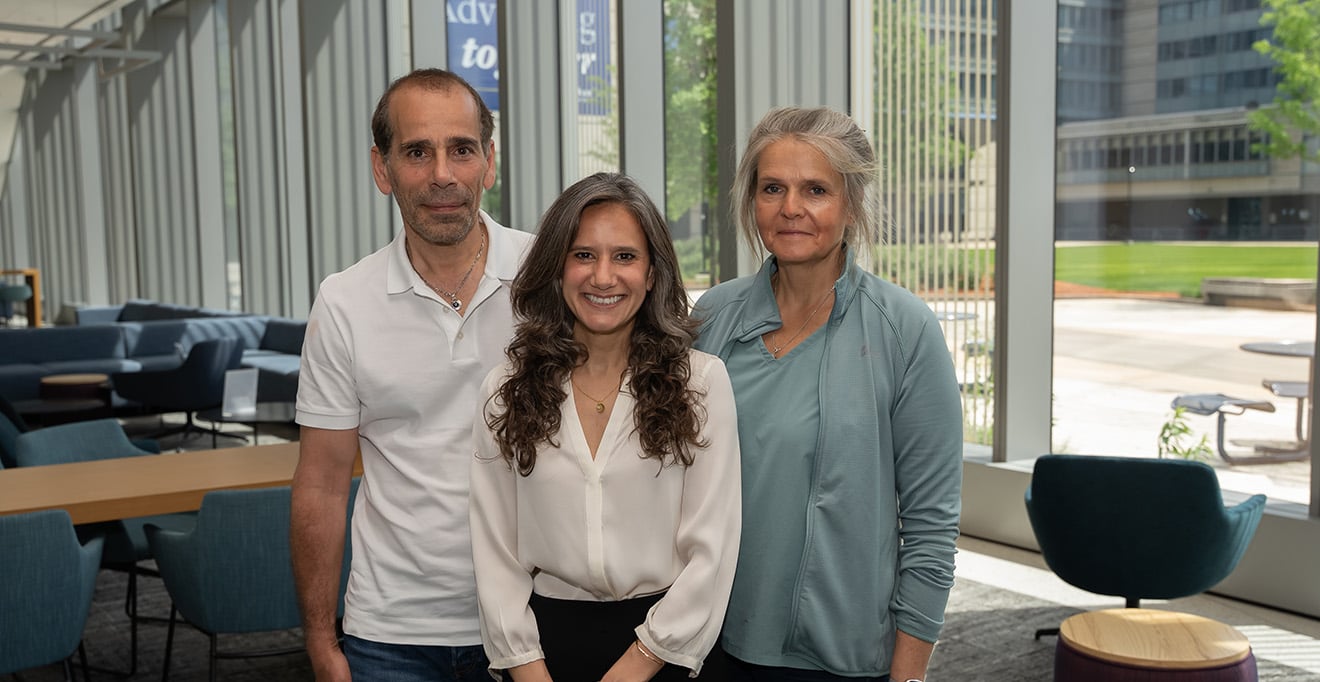
Led by Claudio Punzo, PhD, associate professor of ophthalmology & visual sciences; Anastasia Khvorova, PhD, the Remondi Family Chair in Biomedical Research and professor of RNA therapeutics; and Julia Alterman, PhD, assistant professor of RNA therapeutics, the research shows that by using a chemically modified tetravalent small interfering RNA (siRNA), the therapy could reduce the need for injections to just once or twice a year, resulting in improved quality of life for people with AMD, such as lessening the burden of arranging transportation and appointments.
“A therapy like this could have a major impact for patients with AMD because it could turn eye treatment from something that requires frequent injections into a much longer-lasting therapy,” Dr. Khvorova said.
The findings, published in Molecular Therapy Nucleic Acids, indicate that using the siRNA to turn off ribosomal protein S6 kinase beta-1 (S6K1) through intravitreal injections in the eye is critical to reversing damage and reducing the fatty build up at the Bruch’s membrane, a connective tissue layer in the eye. The research shows that the siRNA platform is a promising intervention for geographic atrophy—a slow, progressive form of dry age-related macular degeneration or dry AMD—and the advanced disease stages of wet age-related macular degeneration or wet AMD, characterized by new blood vessels that break from the back of the eye toward the retina. The vessels are leaky, causing a cumulation of blood fluid in the neural retina.
“The problem with the current therapies for AMD is that they treat late-stage symptoms, particularly when retinal pigment epithelium (RPE) cells die,” Dr. Punzo said. “This therapy should reduce the risk of developing wet AMD and the expansion of visual decline and decrease disease progression.”
Khvovrova and Dr. Alterman have been working with Punzo for years to develop a siRNA-based therapy to specifically target the photoreceptor cells in the eye that remains stable and effective for six months to a year after a single intravitreal injection.
The siRNA therapy targeting S6K1 works by improving the health of RPE cells. It changes the fat composition of photoreceptor cells, whose outer segments are naturally shed and cleared by the RPE. This healthier “diet” for the RPE cells improves their function and helps stop disease progression.
“By delivering RNA medicines directly to photoreceptors and keeping them active in the eye for months, we may be able to protect the light-sensing cells that patients need for reading, driving, recognizing faces and maintaining independence,” Khvorova said.
“Collaboration and cooperation are fundamental for our labs to succeed. Our specialty is in the chemical biology and pharmacology of siRNAs and we partner with disease experts who identify the right genes to target” Alterman said. “Working with Claudio, who spent his career studying and ultimately identifying novel pathways to save and restore vision, is how we can make amazing things happen.”
According to a 2022 study, roughly 18.5 million people in the United States over the age of 40 have early-stage AMD, and 1.5 million are affected by late-stage AMD. About 20 percent of early-stage AMD patients will progress to advanced disease stages that can lead to severe vision loss.
Trinetra Therapeutics, a new siRNA therapeutics company founded by UMass Chan, the UMass Chan scientists and an experienced commercial team, is finalizing the technology licensure and fundraising to bring this new innovation to patients.