

Photo: Kaylee Pugliese
A gene therapy designed by UMass Chan Medical school researchers to correct mutations that cause two different genetic forms of maple syrup urine disease (MSUD) has been licensed to the biotech company Plowshare Therapies.
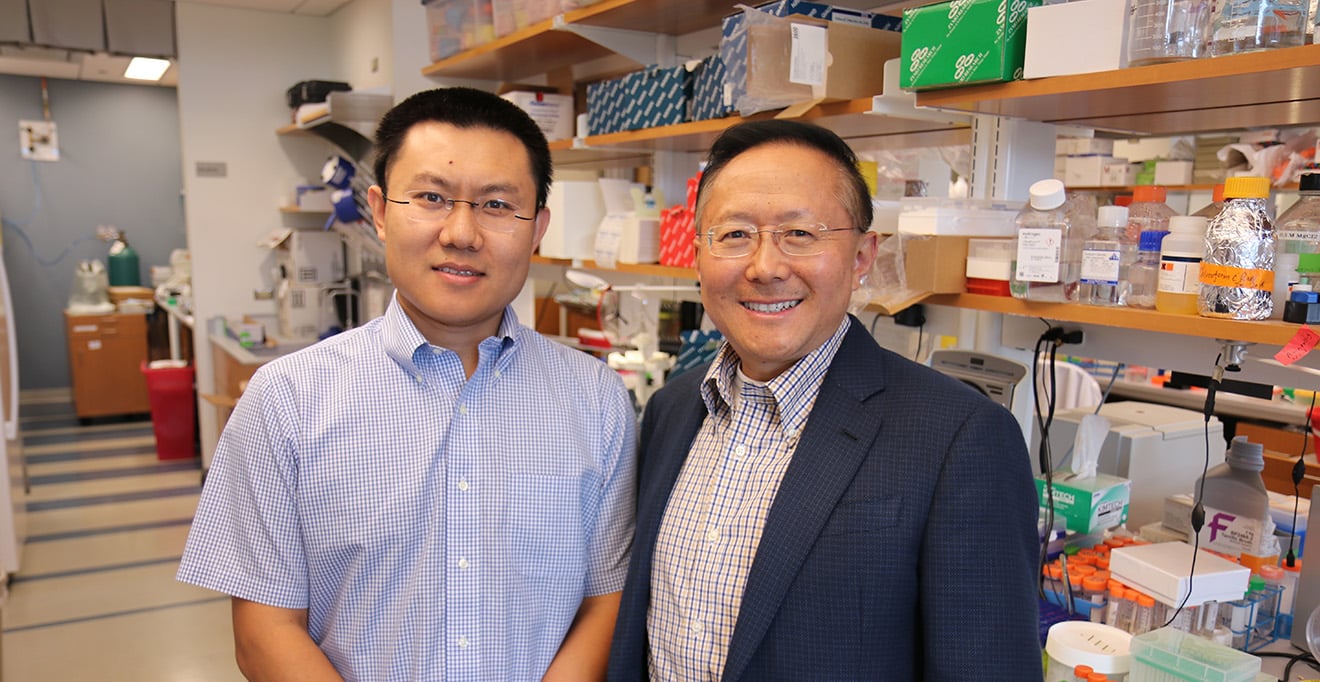
Dan Wang, PhD, assistant professor of genetic & cellular medicine, and Guangping Gao, PhD, the Penelope Booth Rockwell Chair in Biomedical Research, director of the Horae Gene Therapy Center, director of the Li Weibo Institute for Rare Diseases Research and chair and professor of genetic & cellular medicine co-authored a study published in Science Translation Medicine that shows a treatment delivered to animal models by adeno-associated virus (AAV) vector prevented newborn death, normalized growth, restored coordinated expression of the affected genes, and stabilized biomarkers.
“We’re excited by taking this next step with Plowshare Therapies,” said Dr. Wang. “Their clinical expertise and familiarity with the MSUD population makes them the ideal partner to bring this technology from the lab to a clinical setting.”
MSUD is a rare, pediatric genetic disease caused when mutations of the BCKDHA, BCKDHB or DBT gene are inherited from both parents. As a result, the body is unable to break down certain protein components. This leads to the build-up of toxic substances that cause organ and brain damage. MSUD is characterized by recurrent life-threatening neurologic crises and progressive brain injury that can only be managed with an exacting prescription diet or liver transplant from an unrelated donor.
While the condition occurs in about one in 185,000 live births, it is 500-times more common among the Old Order Mennonite communities of Lancaster County, Pennsylvania, where the incidence of MSUD is approximately one in 400.
Often diagnosed based on the results of a newborn screening test, MSUD gets its name because volatile metabolic markers of the disease have the odor of maple syrup. The most common form of MSUD is the classic or infantile form. If left untreated, classic MSUD uniformly results in death within the first few weeks of life.
“Our progress developing an AAV-based therapy for MSUD will strongly benefit from this partnership by accelerating the progression of this much-needed treatment into the clinic. Plowshare Therapies’ knowledge and clinical expertise in the Mennonite and Amish communities is critical to reaching patients and translating these preclinical discoveries into clinical programs,” said Dr. Gao.
Plowshare Therapies was founded to develop gene therapies for rare, severe pediatric diseases. The company is the result of decades of clinical service to Mennonite and Amish communities in Lancaster County, Pennsylvania. Prior to founding Plowshare, Kevin A. Strauss, MD, founder and chief medical officer of Plowshare Therapies, was adjunct professor of pediatrics at UMass Chan Medical School and head of therapeutic development at the Clinic for Special Children in Gordonville, Pennsylvania. As a researcher, Dr. Strauss has been a principal and co-investigator on gene therapy studies, including the MSUD research with Wang and Gao.
“MSUD is a devastating metabolic disorder that causes irreversible brain injury in newborns if left untreated,” said Strauss, “Gene therapy allows us to target certain genetic disorders at their root, potentially rescuing children from death and permanent disability.”