

Photos: Hallie Leo and Pat Sargent
A pair of UMass Chan Medical School junior faculty members are being recognized with prestigious awards for research projects aimed at addressing chronic conditions and disorders in children.
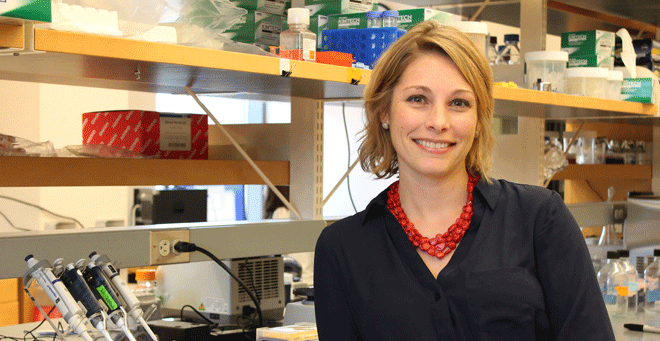
Silvia Galván Peña, PhD, assistant professor of microbiology; and Jin Zhang, PhD, assistant professor of molecular medicine, are two of five recipients of 2026 Charles H. Hood Foundation Child Health Research Awards.
The two year, $200,000 awards are meant to support newly independent faculty members working in nonprofit academic, medical or research institutions in New England. The grants support hypothesis-driven clinical, basic science, public health and health services research and epidemiology projects focused on child health. Dr. Galván Peña’s project will focus on how early life changes in the gut environment impact pediatric autoimmune diseases; Dr. Zhang’s project will focus on how diet, particularly artificial sweeteners, may contribute to childhood obesity.
Galván Peña, who earned her PhD at Trinity College Dublin, joined UMass Chan in 2024 after a postdoctoral stint at Harvard Medical School. Her lab focuses on immunology, particularly on how the gut's immune cells and microbiome impact the rest of the body. The award from the Hood Foundation is her first award as a faculty member.
“Receiving this funding has opened an opportunity in my lab to pursue this research direction, which I don’t think we would have otherwise pursued this early on. This award is very impactful for us,” she said.
Galván Peña’s project, “The Diet-Microbiome-Immune Trifecta: Understanding its Impact on Child Health,” focuses on a group of immune cells, a subset of B cells, that migrate from the gut to other parts of the body in adults, but have not been studied during early life. The aim is to understand how early life changes in the gut environment impact pediatric autoimmune diseases like juvenile arthritis.
“When children develop an autoimmune disease, it's particularly severe because their immune system is still developing. We’re trying to see if, in the specific instance of juvenile arthritis, it's possible that the cells in the intestine that are exposed to a rapidly changing environment are then going into the joints and triggering disease because of these changes in the gut,” Galván Peña said.
Zhang joined UMass Chan in 2022 after completing her PhD at New York University and postdoctoral work at Columbia University. Her lab is interested in the mechanism for sensory modulation and how it interacts with internal physiology.
Zhang’s project, “Diet-driven Tongue Epithelium Reprogramming and Taste Desensitization,” focuses on how diet, particularly artificial sweeteners, may contribute to childhood obesity. Her lab is studying how both sugar and artificial sweeteners desensitize sweet taste, leading to increased consumption and potentially long-term health effects.
“We found that both artificial sweeteners and sugar can alter the architecture of the tongue epithelium, leading to changes in cell function and feeding behavior that may have lasting effects into adulthood,” Zhang said. “Taste acts as an active gate guiding what we consume, and what we eat is fundamental to our health. We want to understand how different diets reshape the sensory system, influence taste perception and ultimately affect metabolic health and disease risk.”
“With this award, we’re really grateful to begin answering these questions,” Zhang added.
Previous UMass Chan faculty recipients of the Child Health Research Award include Fiacha Humphries, PhD, assistant professor of medicine (2022); Gowthaman Uthaman, PhD, assistant professor of pathology (2022); Michael Lodato, PhD, assistant professor of molecular, cell & cancer biology (2020); Megan Orzalli, PhD, assistant professor of medicine (2020); Michela Frascoli, PhD, assistant professor of pathology (2018); Aaron Remenschneider, MD, MPH, adjunct associate professor of otolaryngology (2018); Andrea Reboldi, PhD, associate professor of pathology (2017); Read Pukkila-Worley, MD, professor of medicine (2016); and Dorothy P. Schafer, PhD, the Molly McGovern Chair in Biomedical Research and associate professor of neurobiology (2016). Trudy Morrison, PhD, professor microbiology, received a Major Grant Award from the Hood Foundation in 2016.