

Photo: Bryan Goodchild
Ahnyia Sanders, second-year student in the T.H. Chan School of Medicine, is deeply committed to supporting women of color as they navigate pregnancy and the postpartum period. Thanks to a 2025 Remillard Family Community Service Fund award, she is able to work with that population to improve health outcomes. Her Remillard project, Prenatal Breastfeeding Education, addresses the No. 1 barrier to sustained, exclusive breastfeeding—a lack of prenatal education—and aims to increase breastfeeding initiation and duration rates among Black families in Worcester, which, according to the Massachusetts Department of Public Health, are among the lowest in the state.
For her Remillard project, Sanders organizes and runs a free postpartum support group in Worcester, Black Breastfeeding Circle Support Group, that meets twice a week in a hybrid format, offering a welcoming space to Black women who are pregnant or breastfeeding, to connect.
“The one thing we hear the most from the mothers who attend these groups is how thankful they are that this space exists for Black mothers where they can express their concerns and difficulties with breastfeeding, any fears they might have, and where they can receive encouragement when they need it most,” Sanders said.
Sanders, a certified lactation counselor, divides her time between her studies at UMass Chan Medical School, her job as a doula program coordinator at UMass Memorial Medical Center and overseeing the postpartum breastfeeding support group.
Sanders is also interested in how maternity care systems influence maternal outcomes. Last summer, she shadowed and interviewed midwives at the Karolinska Institute in Sweden to better understand how their model of care contributes to the country’s low maternal mortality rates.
Sanders first began considering a career in medicine at Franklin & Marshall College in Pennsylvania, where she earned her bachelor’s degree in biology and learned about the high infant and maternal mortality rates among Black women, which motivated her to work toward improving these statistics.
Cherise Hamblin, MD, assistant professor of obstetrics & gynecology, director of URiM community workforce development and capacity building for the UMass Chan Collaborative in Health Equity, and director of the UMass Memorial Health Doula Program, is a fellow Franklin & Marshall graduate and a mentor to Sanders.
“Ahnyia has a really clear vision of what her role in women’s health will be, and she’s able to exercise that daily now,” said Dr. Hamblin. “I’m proud of her for finding balance and being laser focused on building a future and a reality that she wants to see. She wanted to see more support around breastfeeding, and she found the opportunity to build it. It’s exciting to watch her star rise.”
A native of Miami, Sanders earned her master’s degree in biomedical sciences from the University of Miami. As the oldest of seven, she often helped care for her younger siblings and witnessed her mother’s difficulties with a lengthy hospital stay while pregnant with Sanders’ younger brother during the COVID pandemic.
Sanders marks that experience as the moment that guided her toward training to become a doula.
“I knew that being a physician was going to take a long time, and I decided to train to become a doula, to be in a role where I can teach people how to advocate for themselves and provide people with education so they can know how to navigate the medical system, and to be there for these mothers as an additional support person,” Sanders said.
As a staff member of the UMass Memorial Doula Program team, Sanders is a point of contact for expecting mothers, from their pregnancy to the birth of their child and through the postpartum period. She helps oversee program operations and patient outreach and works across clinical and community teams to expand access to culturally responsive support.
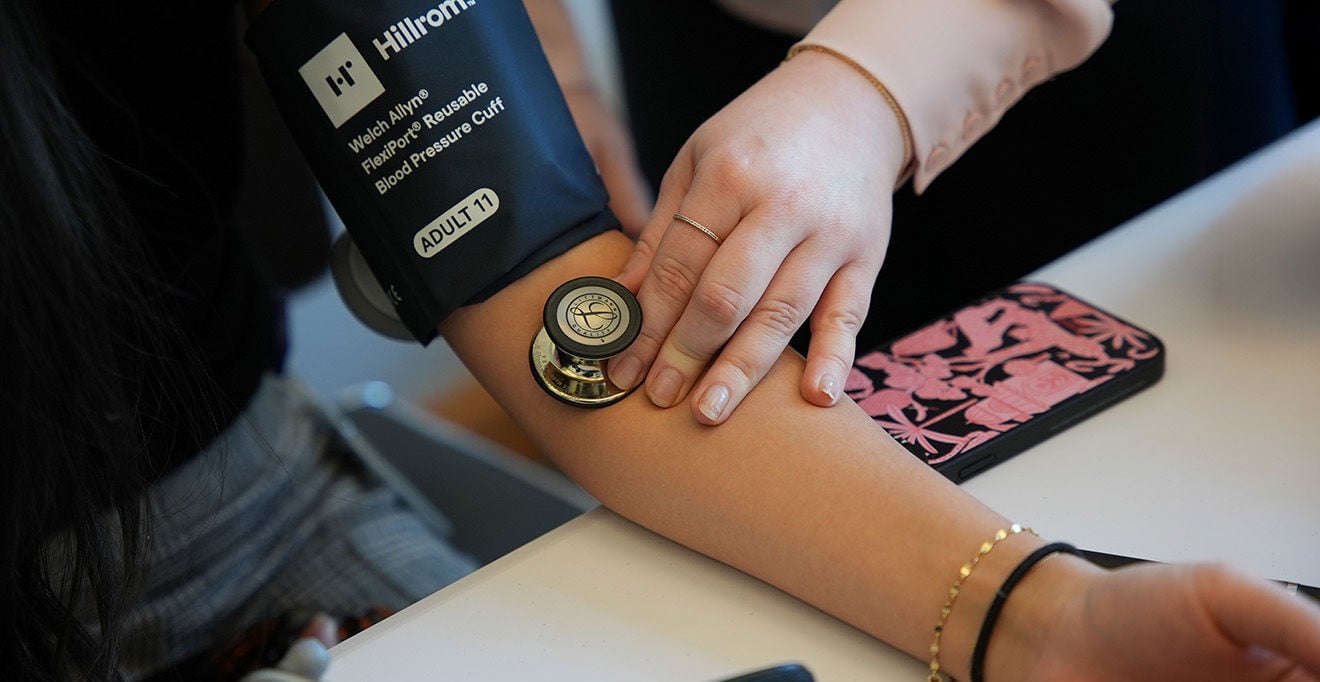
“It’s a rewarding experience working one-on-one with these women. Spending time with mothers, in addition to being a big sister, has made difficult or sensitive conversations feel more natural for me. When we practice patient interviews in our Early Clinical Learning and Longitudinal Preceptorship Program, I have found that my experiences really help me connect with patients, meet their needs and navigate those conversations more comfortably,” Sanders said.
Sanders plans to specialize in obstetrics and gynecology and hopes to influence maternal health policy at the national level, building on the community programs and research that shaped her path into medicine.