

Photo: Kaylee Pugliese
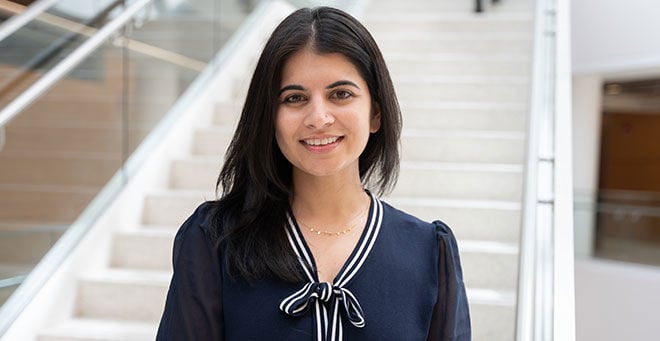
The largest ever nationwide study on the effectiveness of school-based health centers is being led by Michelle K. Trivedi, MD’09, MPH, associate professor of pediatrics and vice chair of research career development at UMass Chan Medical School.
Dr. Trivedi, a pediatric pulmonologist and asthma researcher, received a $3.86 million grant from the National Institutes of Health to lead the study aiming to answer questions about which children and communities benefit most from school-based health centers, and to determine if school-based health centers are providing effective healthcare and improving health outcomes for underserved communities and low-income families.
School-based health centers are independent primary care offices inside or attached to schools that are accessible to students, parents and community members. There are nearly 4,000 school-based health centers across the U.S. However, clinicians and researchers don’t fully understand their effectiveness or whether they are helping families access the best healthcare.
The landmark study will collect data from 2.7 million visits at nearly 600 school-based health centers in up to 30 states, including Massachusetts. This data will then be compared to similar, existing data from community health centers, totaling over 24 million visits. The research team will examine whether school-based health centers’ outcomes are different from community health centers. They will also examine individual and community-level data on social drivers of health, as well as interview families, school-based health center staff policymakers and public health leaders.
“This will be the first study of this scale comparing school-based health centers with traditional community health centers. For the first time, we will be able to link social drivers of health data to the effectiveness of care in these centers,” said Trivedi. “This research has the potential to inform policy and future implementation of these innovative health delivery systems.”
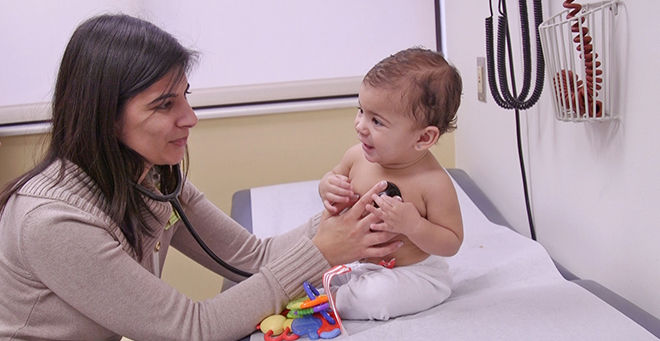
As part of the study, Trivedi and her team will be looking at data to determine if school-based health centers improve healthcare delivery for asthma and reduce asthma exacerbations.
“Asthma impacts more than six million children in the United States,” said Trivedi. “It is a leading cause of emergency room visits and hospital admissions and predominantly impacts low-income children and communities.”
According to the Center for Disease Control and Prevention, in 2020, nearly 8 percent of school-aged children in Massachusetts had asthma. However, as few as 20 percent of children are receiving evidence-based asthma care, resulting in preventable symptoms and asthma attacks.
“School-based health centers exist to provide access to care for the millions of families that cannot consistently make it to a traditional health clinic,” said Trivedi. “Looking at asthma care, we will access the impact school-based health centers have on patient care compared to the standard community-based health care clinic.”
Co-investigators on the project include Sarabeth Broder-Fingert, MD, MPH, professor of pediatrics, vice chair of clinical research in the Department of Pediatrics, and executive director of the Eunice Kennedy Shriver Center at UMass Chan; Sybil Crawford, PhD, professor of nursing; and Arvin Garg, MD, MPH, professor of pediatrics.
Trivedi and her team are working with OCHIN, a research-based health information network, to compile the data from the school-based health centers.