

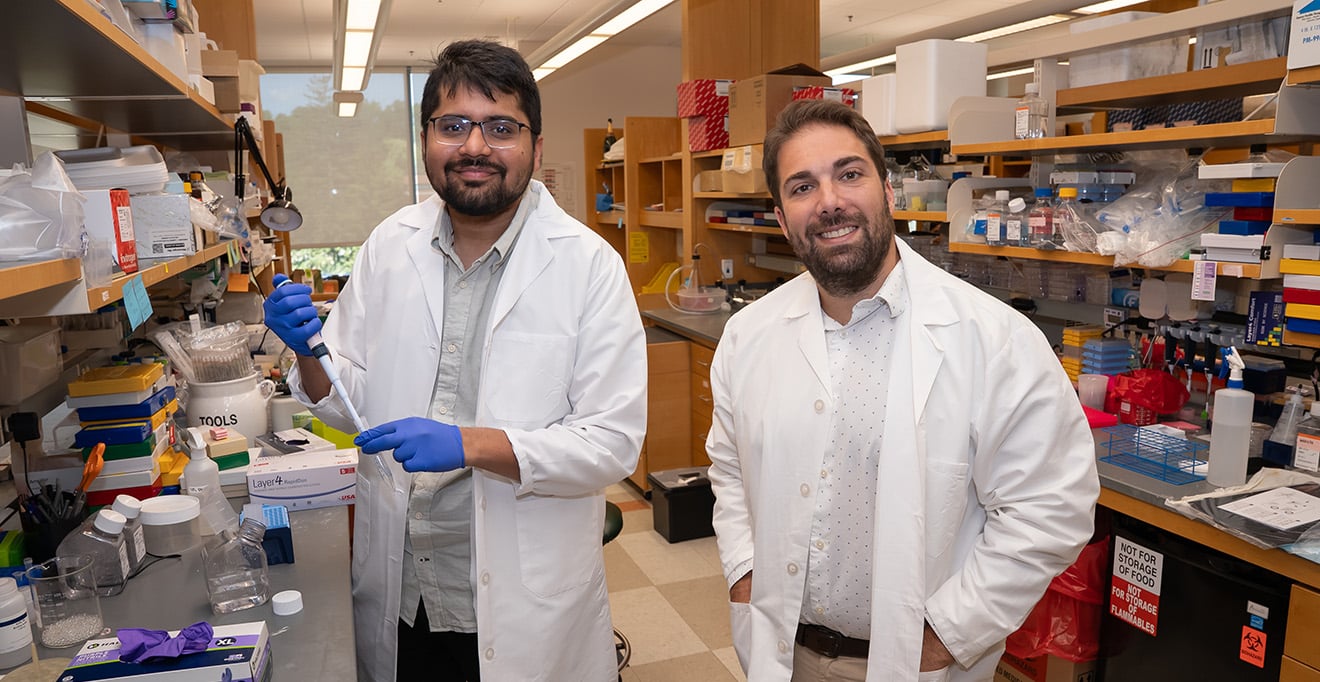
Photo: Bryan Goodchild
Inspired by the work of the RNA Therapeutics Institute at UMass Chan Medical School and the development of the COVID vaccine, Marcus Ruscetti, PhD, and Chaitanya Naimesh Parikh, PhD’26, have developed an immunotherapy using a cocktail of messenger RNAs (mRNA) that could potentially be transformative for pancreatic cancer treatment.
The study, published in Nature Communications, combines immune cytokine and tumor-associated antigen mRNAs into a single injection to treat pancreatic ductal adenocarcinoma. Approximately 50 percent of mice with pancreatic cancer treated with the mRNA immunotherapeutic cocktail saw complete tumor responses and more impressively, remained disease free for a year, even after treatment had been stopped.
“It’s unheard of to get a response like this in these models of pancreatic cancer,” said Dr. Parikh, a recent PhD graduate from the Ruscetti Lab. “There have been a lot of drugs tried in the lab that have had good initial responses in mice but ultimately the cancer always comes back. This is the only study I’ve seen that has achieved durable tumor protection.”
Dr. Ruscetti, associate professor of molecular, cell & cancer biology, added, “Going from mice into patients takes a huge effort and is never a sure thing. However, if there was one approach I had to bet on being successful, this is the one. And that’s what we’re doing.”
Pancreatic ductal adenocarcinoma is the most common and aggressive type of pancreatic cancer. It starts inside the tiny tubes that carry digestive juices out of the pancreas. Because early signs are hard to notice, pancreatic cancer is often found after it has spread to other organs. The five-year survival rate for stage IV of the disease is 3 percent, while the overall survival rate for all stages is 13 percent.
Immunotherapies have emerged as an incredibly effective treatment strategy for certain cancer types. These drugs use the power of the body’s own immune system to find, control and destroy cancer cells. In the 1980s and 1990s, cytokines–tiny proteins, such as interleukins, interferons and tumor necrosis factors released by cells that act as chemical messengers to recruit, activate and produce immune cells–were used to stimulate the immune system into fighting cancer cells. Unfortunately, these early attempts turned on the body’s entire immune system, causing a system-wide reaction that had dangerous side effects and did not eradicate most tumors.
Thanks to decades of basic biological research, scientists now know the specific cytokines that activate the immune system to fight different kinds of foreign and damaged cells, including pancreatic cancer. “What we need is a way to get these immune signals to the tumor so they can do their job,” said Ruscetti.
Pancreatic tumors, however, are very good at hiding from immune cells. The cancer cells build a fibrotic barrier around the tumor, like a wall around a castle, that keeps immune cells at bay. To fight off the cancer cells, the immune system must break down this wall and get its cells into the tumor environment in a way that doesn’t exhaust its ability to mount a defense while also recognizing tumor cells as foreign material that need removing.
“All these steps are lacking in pancreatic cancer,” said Ruscetti. “That’s where the mRNA comes into play.”
mRNAs carry the genetic instructions necessary for building proteins–such as cytokines and antigens. They act as a temporary copy of a gene that is then translated into a protein. When injecting mouse models with five cytokine mRNAs, combined with three tumor antigen mRNAs that help the immune system “see” the pancreatic tumor cells as foreign materials, Ruscetti and Parikh observed a reduction in fibrotic material and increased tumor cell necrosis.
Approximately half of the mice treated experienced complete remission that continued up to one year after treatment had been stopped, potentially indicating that the immune system had established a long-term “memory” of the pancreatic cancer cells.
“This is a first-of-its-kind approach combining cytokine mRNAs with tumor associated antigen mRNA that could pave the path for effective immunotherapy for pancreatic ductal adenocarcinomas,” said Parikh. “Beyond this cancer, this mRNA immunotherapy strategy has the capacity to be modular and can potentially be used as a platform to treat other types of immune-resistance cancers simply by swapping out different mRNA sequences.”
Initial funding for the study was provided by the Worcester-based Pancreatic Cancer Alliance, a patient advocacy group that supports pancreatic cancer research at UMass Chan. Researchers are now developing a potential IND-ready product of the cocktail in preparation for future clinical trials.