
Photo: Bryan Goodchild
From patient portals and text messages to wearable devices and artificial intelligence, digital health technologies are becoming a significant part of medical care. But technology alone isn’t enough to improve health outcomes.
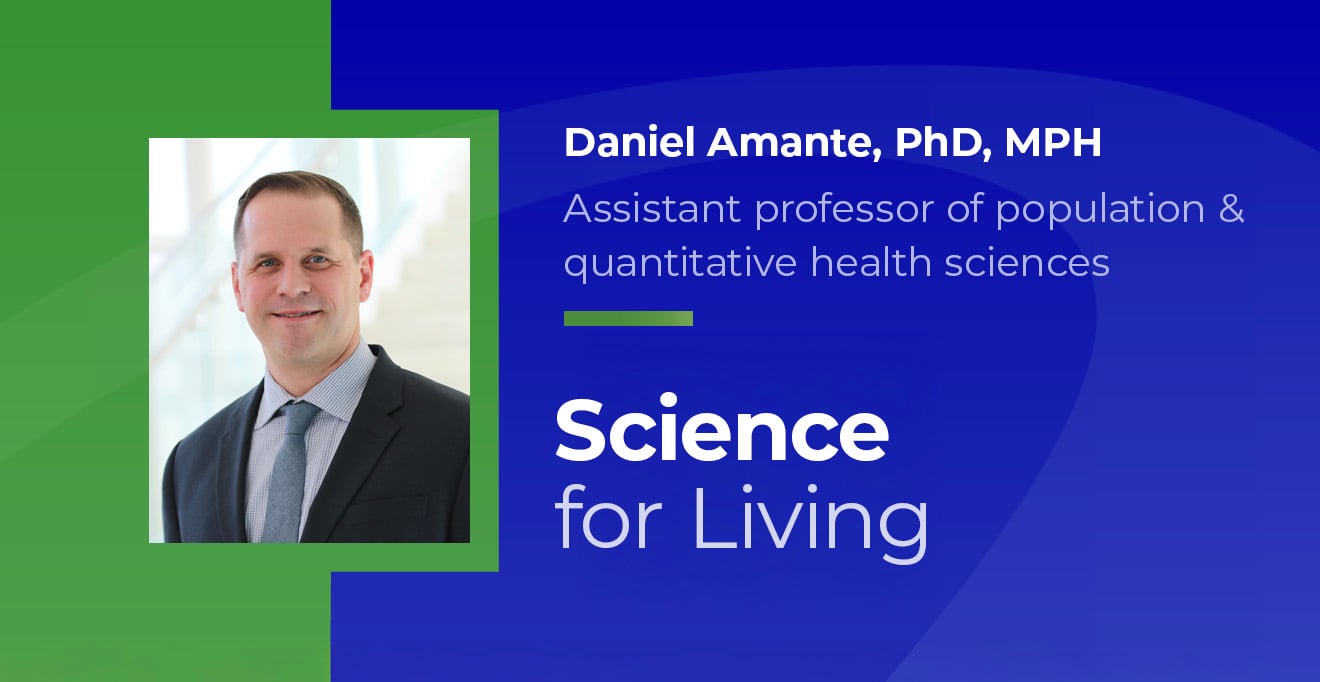
According to Daniel Amante, PhD, MPH, assistant professor of population & quantitative health sciences at UMass Chan Medical School, the most effective tools are those designed with the end users input upfront to address specific challenges that both providers and patients face. Dr. Amante specializes in implementation science and the use of health informatics, patient-facing technologies and behavioral economics to enhance health care delivery and support for patients with chronic diseases.
“The most effective interventions leverage technology but still keep human support and care at their core,” Amante said
Building tools patients actually use
Amante’s research focuses on patient-facing technologies, particularly tools that already exist within health systems but are often underused or misunderstood. One example is the patient portal, such as MyChart, which allows patients to access test results, schedule appointments and communicate securely with providers.
“These tools are available to almost everyone, but their use and implementation in clinical care is sometimes suboptimal,” Amante explained. “Patients may sign up without really knowing what the portal can do or how it can support their care.”
Early in his career, Amante focused on improving adoption and appropriate use of patient portals, helping patients understand not just how to use the technology, but when. “A single, succinct message asking for a follow-up call can be much more effective than multiple messages,” he said, noting that thoughtful use benefits both patients and providers.
Closing the digital divide
Smartphones have dramatically expanded access to digital health tools. “From an access standpoint, the digital divide has shrunk,” Amante said. “You’re carrying a computer in your pocket.”
However, disparities remain. While many people now have smartphones, differences in how effectively technology is used persist, particularly among people with limited health literacy, lower socioeconomic status or limited English proficiency.
“The access divide has narrowed, but the use divide is still there,” Amante said. “That’s where training, support and thoughtful design really matter.”
His current work includes efforts to improve portal use among Spanish-speaking patients. While MyChart is available in Spanish, Amante noted that language access alone isn’t enough. “People are often asked to sign up without ever being trained,” he said. “We need to guide people through initial use and show them how these tools can actually help.”
Text messaging
In addition to portals, Amante studies text messaging as a low-cost, high-impact way to support patients—particularly those managing chronic conditions like diabetes.
“Text messaging is basic technology, but it has high access and good patient acceptability,” he said. “It’s less likely to feel like junk than email, and it fits into people’s daily lives.”
A key element of this work is patient-centered design. Rather than relying on fully automated or generic messages, Amante involves patients early in the design process to help develop the content itself. Patients with lived experience collaborate on drafting and refining messages, ensuring that behavioral tips reflect real-world challenges and language that resonates. “Patients help develop the messages, so behavioral tips are coming from people like them,” he explained. “That improves acceptability and engagement.”
Turning evidence into action
One of Amante’s recent studies focused on increasing participation in diabetes self-management education and support, an evidence-based program recommended for all people with diabetes. Despite its proven benefits, participation remains low.
“We know this works,” Amante said. “When patients complete this education, their diabetes control improves. But very few people actually receive it.”
His team developed a technology-enabled intervention to address barriers that often go overlooked, such as scheduling challenges, long wait times and loss of motivation. Patients received help setting up the patient portal, learned key features, and then received peer-written text messages during the weeks leading up to their first education appointment.
“The goal was simple,” Amante said. “Get patients to show up and have a better experience with care we already know is effective.”
Patients were also encouraged to share personal goals—such as walking a dog or practicing yoga—which were communicated to educators ahead of visits. “That way, care is already personalized before the visit even begins,” he explained.
Wearables, remote monitoring and AI
Looking ahead, Amante sees growing potential in wearable and remote monitoring devices, from continuous glucose monitors to smartwatches and rings that track heart rate and other health metrics.
“The challenge is data,” he said. “These devices generate huge amounts of information, and it can be overwhelming.”
Artificial intelligence may help by turning raw data into actionable insights. “AI and machine learning can help interpret trends, support clinical decision-making and generate content that helps providers care for patients more efficiently,” Amante said.
Still, he emphasized that technology should never replace relationships. “Patients still want a provider they know and trust,” he said. “The goal is to integrate technology into those relationships, not remove the human connection.”
Setting expectations
Patient portals can present challenges for clinicians, particularly when lab results are released before providers have had time to review them. “Patients start Googling, get worried and reach out immediately,” Amante said.
Part of Amante’s work focuses on setting clearer expectations around how and when patient portals should be used, helping reduce unnecessary anxiety and miscommunication. He works to ensure patients understand that portals are best suited for nonurgent communication and follow-up questions, not immediate concerns. “The portal isn’t for urgent, in-the-moment support,” he explained. “For immediate concerns, calling the office or speaking with a nurse may be more effective.”
The future of digital health
As technology continues to evolve faster than health care systems, Amante believes collaboration is essential. “Providers and patients are both my customers,” he said. “Each has challenges, and my job is to figure out how technology can help address those challenges safely, ethically and equitably.”
The ideal future, he said, is one where data-driven tools support patients, strengthen relationships and improve care, without losing the human side of medicine.